
Ask ten nurses which compression socks to buy and most will answer with a number: 20–30 mmHg, because it is the figure that sounds serious enough to be doing something. Ask what that number is doing to a leg across a twelve-hour shift and the answers thin out quickly, which is reasonable, because the research is more interesting than the marketing.
This guide is written from the manufacturing side of the table. We knit compression socks for scrub brands and health systems, which means we spend our time on the three variables that actually decide whether a sock works: the pressure profile, the fit, and how long the elastane holds. The number on the packet is only the first of those.
The short answer
For everyday wear on a long shift, 15–20 mmHg is the sensible default. Studies on working adults found that both 15–20 and 20–30 mmHg reduced end-of-day leg swelling, with the larger reduction at the higher pressure, while other work concluded that 10–15 mmHg is already enough to prevent occupational swelling, and a meta-analysis of eleven trials found no measurable difference between 10–20 and 20–30 mmHg for that purpose.
Fit matters more than the number. A sock in the wrong calf size does not deliver the pressure printed on the pack, and compression hosiery is mis-sized far more often than people assume. Buy to your calf circumference, not your shoe size, and replace the pair every three to six months, because compression is elastane and elastane relaxes.
Why legs swell on a twelve-hour shift
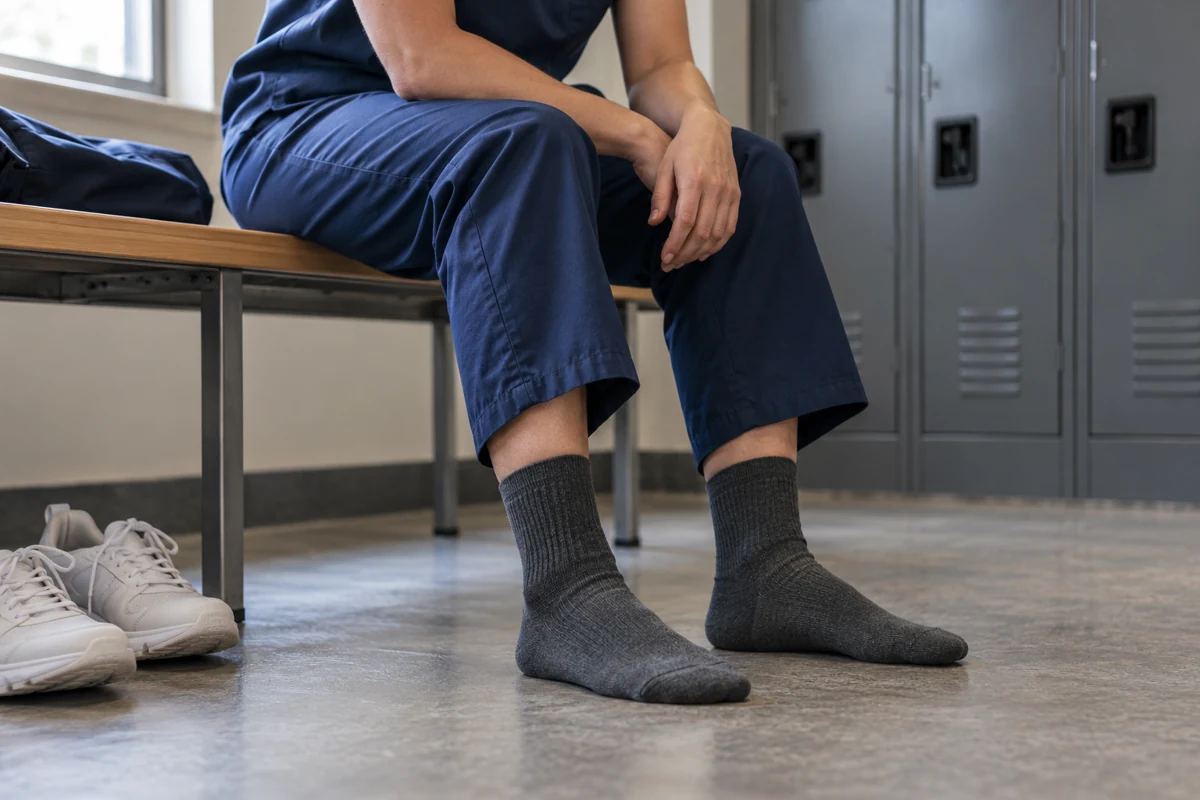
Standing still is harder on the venous system than walking. The calf muscle acts as a pump that pushes blood back towards the heart, and when a leg is loaded but static the pump works inefficiently, so blood pools in the lower limb and pressure rises in the veins. Prolonged standing at work has been linked to chronic venous disorders, leg fatigue and lower back pain, and the day-to-day version most clinicians recognise is simpler: heavy legs, tight shoes by late afternoon, sock marks that take an hour to fade.
This is measurable rather than anecdotal. One study of seventy health professionals working twelve continuous hours found a significant increase in leg volume across the shift, regardless of which part of the day they worked, with the rate of swelling actually higher on the morning shift. Another found that in nursing students, 97 per cent reported lower-limb pain and 87 per cent reported swelling after clinical placement hours.
What the pressure research actually found
The most directly useful study for someone standing all day measured fifty-eight working adults across three consecutive days. Day one was without stockings, day two with 15–20 mmHg knee-length stockings, day three with 20–30 mmHg. Participants were grouped by posture: mostly sitting, mostly standing, or a mixture. End-of-day leg volume dropped significantly on the compression days in all three groups, and the reduction was greater with the higher pressure.
That sounds like a straightforward argument for buying the strongest sock available, but the same literature pulls in the other direction. One conclusion cited in that work is that around 10–15 mmHg is enough to prevent occupational swelling, that less than that is ineffective, and that more may add nothing. A meta-analysis covering eleven randomised trials found no difference between 10–20 and 20–30 mmHg for preventing occupational oedema.
The practical reading is this: the pressure that helps you is the pressure you will actually keep on for the whole shift. A 20–30 mmHg sock that comes off at hour seven because it is uncomfortable does less for your legs than a 15–20 mmHg sock worn from six to six. Compliance is the variable nobody prints on a label.
| Pressure class | Typical use | What to expect on a shift |
|---|---|---|
| 8–15 mmHg | Light everyday support | Noticeably snug rather than tight. Suits people who have never worn compression and will not tolerate more. |
| 15–20 mmHg | The occupational default | Enough to reduce end-of-day swelling in standing work, light enough for all-day compliance. The usual choice for scrub socks. |
| 20–30 mmHg | Symptom-led wear | Larger measured reduction in swelling, but harder to put on and more likely to be abandoned mid-shift. Commonly recommended for existing venous symptoms, and worth discussing with a clinician first. |
| 30–40 mmHg and above | Clinical use | Prescription territory. Not a workwear decision. |
Graduated versus progressive compression
Almost every sock sold to nurses is graduated: tightest at the ankle, easing as it climbs the calf. The logic is that the gradient helps push fluid upward. It is the default because it is the convention in medical hosiery, where the goal is usually treating a diseased vein.
There is a second profile that gets far less attention and is arguably better suited to a healthy leg standing all day. Progressive, sometimes described as antigraduated, stockings put the higher pressure at the calf rather than the ankle. In a comparison on healthy volunteers, progressive stockings were easier to put on, slightly more comfortable, and produced a significantly greater reduction in occupational swelling than graduated ones.
This matters for anyone specifying a sock rather than buying one off a shelf. If the product is being sold for comfort during long shifts rather than for treating a venous condition, the progressive profile deserves to be on the table. It is one of the options we knit on our custom scrub socks line, and it tends to surprise brands who assumed graduated was the only serious choice.
Why fit beats pressure
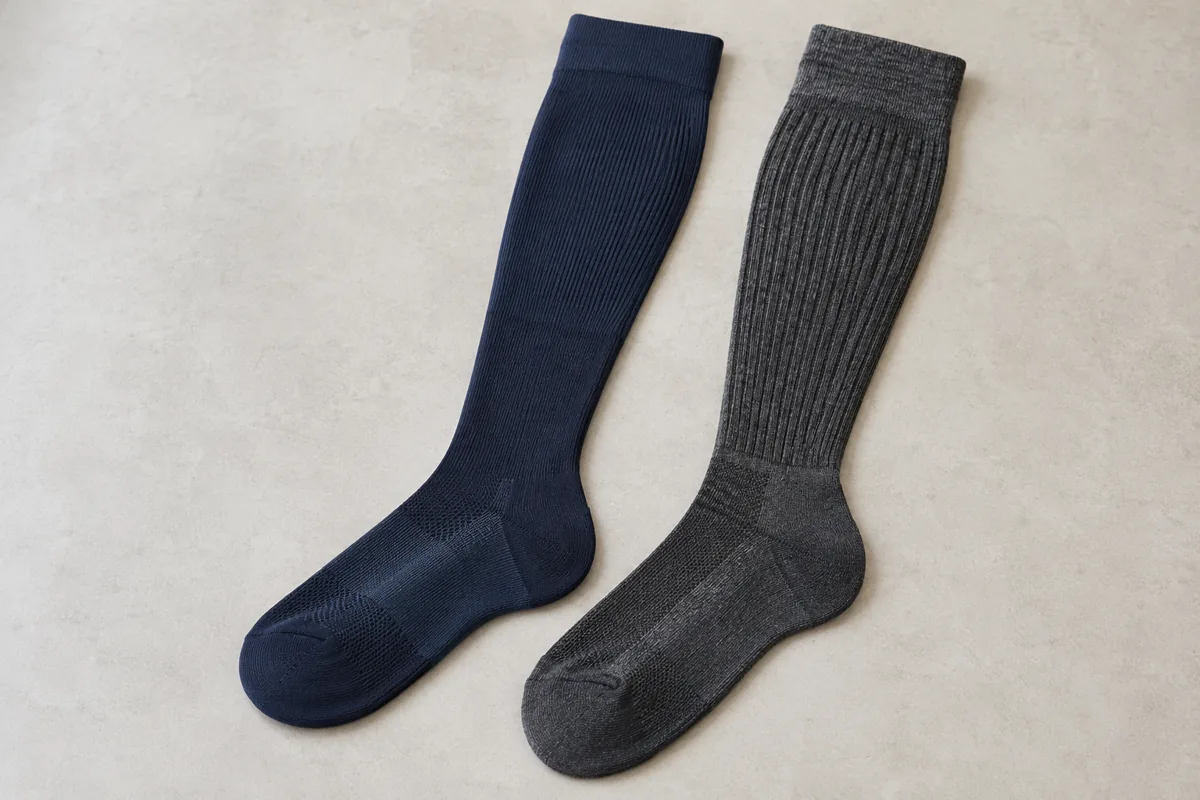
A compression sock is a pressure device whose output depends on how far the fabric is stretched. Stretch it over a calf larger than the one it was engineered for and the pressure climbs above the label; put it on a calf smaller than intended and the pressure falls below it. The number on the packet is a promise conditional on fit, and it is broken often. A study reported in the American Journal of Nursing found compression stockings were incorrectly sized in just under thirty per cent of cases examined.
Three practical consequences follow.
Measure the calf, not the foot. Most sock sizing is still printed as a shoe-size range, which tells you nothing about the dimension that actually generates the pressure. The widest point of the calf is the measurement that matters, taken in the morning before any swelling has started.
Sizing up is not a fix. Going up a size to escape a cuff that bites does not give you a gentler version of the same sock; it gives you a sock delivering materially less pressure than the one you paid for. Research examining deliberately oversized strong stockings found the hemodynamic effect changes with the fit, not just the comfort.
Wide calf is a size, not an apology. A product range that stops at a 17-inch calf and tells everyone else to buy men’s has an engineering gap, not a customer problem. Blocks graded past 22 inches exist for a reason.
Knee-high, crew or thigh
Knee-high is the standard for occupational compression, and the evidence supports not reaching higher without a reason. A randomised trial comparing knee-length and thigh-length compression stockings worn by nursing students through clinical shifts found no significant difference in pain, swelling or satisfaction between the two lengths. Satisfaction was slightly higher in the knee-length group, and the only side effects reported, tightness and itching, came from the thigh-length group. The authors concluded that knee-length is the sensible recommendation for students on placement.
Crew-height compression socks sit at 8–15 mmHg territory and occupy a different job entirely. They will not do much for calf swelling, because they do not cover the calf. What they will do is get worn, by the large group of staff who find knee-highs too warm, too visible or too much effort at five in the morning. For a brand building a range, that is a volume product rather than a compromise.
Wearing them, washing them, replacing them
Compression socks are put on before the legs have had a chance to swell, which in practice means before getting out of bed or at least before the commute, and taken off at the end of the day rather than slept in unless a clinician has said otherwise.
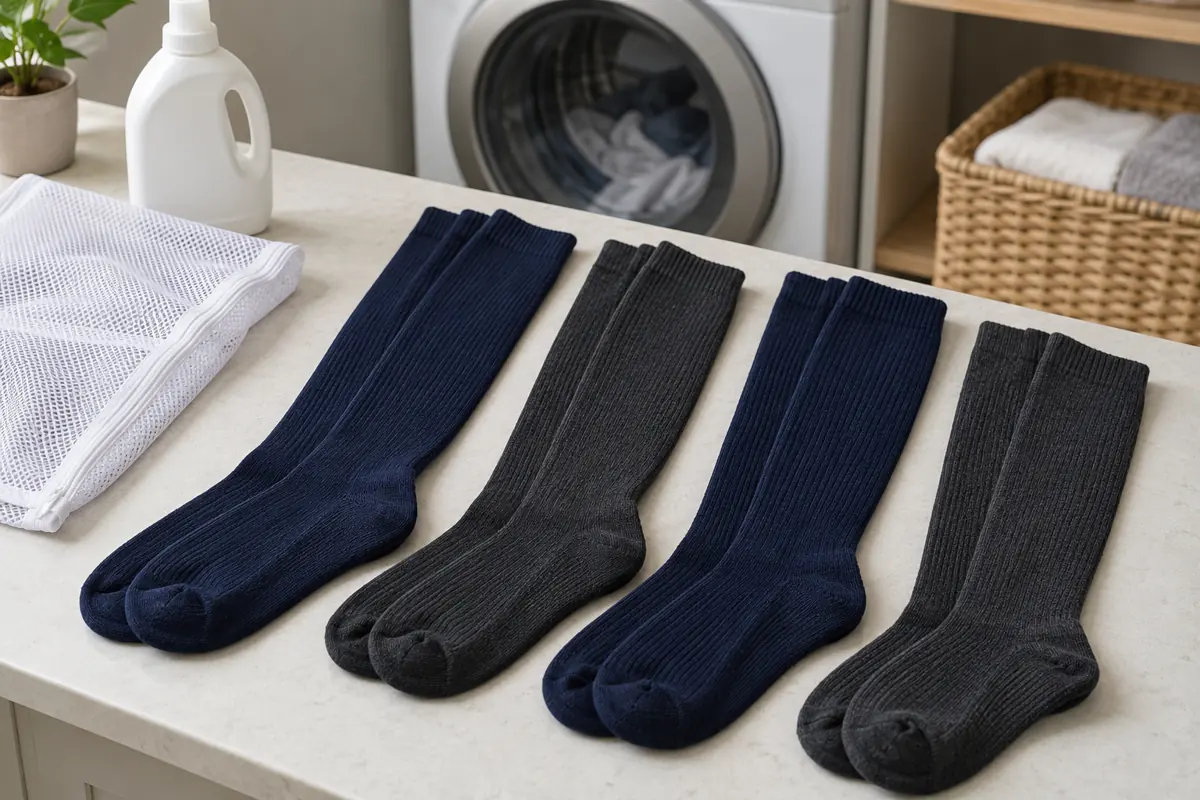
Washing is not optional maintenance. Daily washing is recommended across the category because it helps the elastic fibres recover their shape, and because skin oils, lotion and sweat break those fibres down. Cool or warm water, mild detergent, and heat kept away from the elastane.
Replacement is where most people lose the benefit without noticing. The figure published across the industry is three to six months of regular wear, sooner if one pair is worn daily without rotation. The failure is gradual, which is the problem: the sock gets easier to put on, stops leaving a mark, and feels comfortable right up until it is doing nothing. Easier to pull on than it was in month one is the clearest signal that a pair is finished.
If you are buying for a whole team
Everything above changes scale when the order is eight hundred pairs for a department or a first production run for a scrub brand. An individual who buys the wrong size returns it. An organisation that specifies the wrong size curve owns the mistake for a year, and a brand that launches on a sock that loses its cuff by week eight loses the reorder, which is the order the business case depended on.
What to put in writing before you order
- Pressure class and profile. State the mmHg range, state whether it is measured at the ankle or the calf, and state whether the profile is graduated or progressive.
- Calf-based size curve. Size bands defined by calf circumference, including wide and extra-wide, not by shoe size alone.
- Cuff specification. Welt depth and elastane content specified separately from the leg, with a non-roll requirement.
- Toe closure. Hand-linked or flat closure named explicitly. A raised toe seam inside a closed clog is a guaranteed complaint.
- Retention after washing. Ask for compression retention to be checked against a sealed sample after a stated number of wash cycles, at your actual laundering temperature.
- Claim wording. Decide early whether packaging claims comfort or claims a medical effect, because that choice carries regulatory consequences in the United States.
Those six lines are the difference between a sock that is specified and a sock that is merely ordered. We set out the full build detail, from knitting gauge to pack format, in our private label scrub sock spec sheet.
Frequently asked questions
What mmHg compression socks should a nurse wear?
For general use on a long shift, 15–20 mmHg is the common recommendation and the level most people tolerate for twelve hours. Research on working adults found greater reductions in swelling at 20–30 mmHg, but also found that lighter pressures of 10–15 mmHg are enough to prevent occupational swelling, and one meta-analysis found no difference between 10–20 and 20–30 mmHg for that purpose. Anyone with an existing venous or arterial condition should have the level chosen by a clinician.
Are compression socks actually worth it for nurses?
For end-of-day leg swelling in people who stand all day, the measured effect is consistent across studies. One crossover trial in hairdressers found reduced leg volume and discomfort with compression, and symptoms returned once people stopped wearing it. A comparison against neuromuscular stimulation devices found compression stockings were the only method that effectively reduced lower-limb swelling. They are not a cure for a venous condition, but as workwear they do something measurable.
Can you wear compression socks for 12 hours straight?
Correctly sized socks in the 15–20 mmHg range are generally worn through a full working day and removed at the end of it. Pain, numbness, tingling, colour change or skin marks that do not fade are signs the fit or the pressure is wrong, and are reasons to stop and get advice rather than to push through.
Why do my compression socks roll down or cut into my calf?
Almost always a cuff and sizing problem rather than a compression-class problem. The welt may be too narrow, too strong relative to the leg, or the sock may simply be too small at the calf. Measure the widest point of the calf and buy to that figure, and look for a deep non-roll welt rather than a thin elastic band.
How often should compression socks be replaced?
Every three to six months with regular wear. Rotating between several pairs extends the life of all of them. The most reliable sign of a finished pair is that it has become noticeably easier to pull on than when it was new.
Knee-high or crew for nursing?
Knee-high if the goal is reducing calf and ankle swelling, since that is the area the sock has to cover to act on it. Crew height is the better answer for anyone who will not reliably wear a knee-high, because a lighter sock that is actually worn beats a stronger one left in a drawer.
Where this fits, and what to read next
We manufacture custom wholesale scrub socks for brands, distributors and health systems, in graduated and progressive profiles and in cushioned everyday knits, graded to real calf measurements rather than shoe size alone.
- Private label scrub socks: the spec sheet — Needle count, yarn, toe closure, cuff and claim wording before you order a sample.
- Buying medical scrubs in bulk — Nine complaints from real reviews, and the spec lines that prevent each one.
- Custom wholesale underscrubs — The other high-frequency layer clinicians buy in multiples.
- Will these survive commercial laundry? — The test methods to name when garments go through industrial washing.
- MOQ per style versus per colourway — The minimum that decides how many colours you can actually launch.
Specifying socks for a brand or a department?
Send your pressure class, colour range and quantities. You get an itemised quote and a production timeline within one business day, with the size curve and cuff specification written in before you commit.