
Most guides to buying scrubs in bulk are written from the supplier’s side of the table: here are our fabrics, here are our minimums, here is the quote form. This one is written from the other end. We spent time in the places where the people who actually wear scrubs for twelve hours talk about them — nursing forums and subreddits, and the customer review sections of Amazon, Walmart and eBay listings — and sorted the recurring complaints into the ones a bulk buyer can prevent at specification stage.
That distinction matters more in bulk than it does in retail. A consumer who buys a bad scrub top returns it. A clinic that buys eight hundred of them owns the problem for three years, and a brand that launches on them loses the second order, which is the one the business case depended on.
The short answer
Nine complaints account for most of the negative feedback healthcare workers post about scrubs: pilling, see-through fabric, inconsistent sizing, unusable pockets, branding that washes off, colour fade and drift, seams opening, heat and odour retention, and fit that ignores how people move.
All nine are preventable, and none of them are prevented by choosing a more expensive supplier. They are prevented by naming a fabric weight, a test method and a tolerance in the order — and by keeping a sealed sample so the fourth production run can be measured against the first.
Where this evidence comes from
Three sources, each with a different bias worth naming.
Forum discussion is where you find the complaints people make when they are not talking to a brand. It skews toward frustration and toward the well-known labels, because those are what people have opinions about. Its value is that it surfaces failure timelines — not “this is bad” but “this was fine until month seven”, which is exactly the information a datasheet will not give you.
Marketplace reviews on Amazon, Walmart and eBay listings skew the other way: a lot of five-star reviews written in the first week of ownership, before anything has had time to fail. The useful signal sits in the one- and two-star reviews and in the structured fit data these platforms now publish. When a listing carries a sizing sentiment flag, that is thousands of returns compressed into a single line.
Product listings themselves tell you what buyers are being sold on. The pocket-count arms race is visible at a glance: listings now compete at six, seven, nine, ten and eleven pockets. That is a market responding to a real complaint, and responding to it by counting rather than by designing.
The nine complaints, and the spec line for each
1. “They pilled within months”
The most repeated durability complaint across forums, and notably it is aimed at premium brands as often as budget ones. People describe paying a premium price and watching fabric go fuzzy at the inner thigh, underarm and anywhere a badge reel rubs.
The spec line: pilling resistance graded under ASTM D3512, the random tumble pilling test, on a 1 to 5 scale where 5 means no pilling. Ask for the grade in writing. A supplier who has never tested cannot give you a number, and that absence is itself the answer.
2. “You can see straight through them”
Two distinct versions of this complaint. Light colours go translucent under strong clinical lighting. Dark bottoms go translucent under tension, at the seat and across the thigh, which the wearer discovers while bending over a bed.
The spec line: fabric weight quoted under ASTM D3776 for the specific colour and finish you are ordering, not as a single catalogue figure across the range. Dye and finish both change mass, so one number across every shade is an average that is wrong for each colour individually. Step the weight up on whites and on dark bottoms as a rule rather than as an upgrade. Our guide to scrub fabric weight goes into the ranges.
3. “The sizing is inconsistent”
This is the complaint with the widest reach, because it is not about one garment failing. It is about a medium in one style not matching a medium in another style from the same brand. For an individual that is an annoying return. For a facility rolling out to two hundred staff it is a sizing day, a re-order and a budget line nobody planned for.
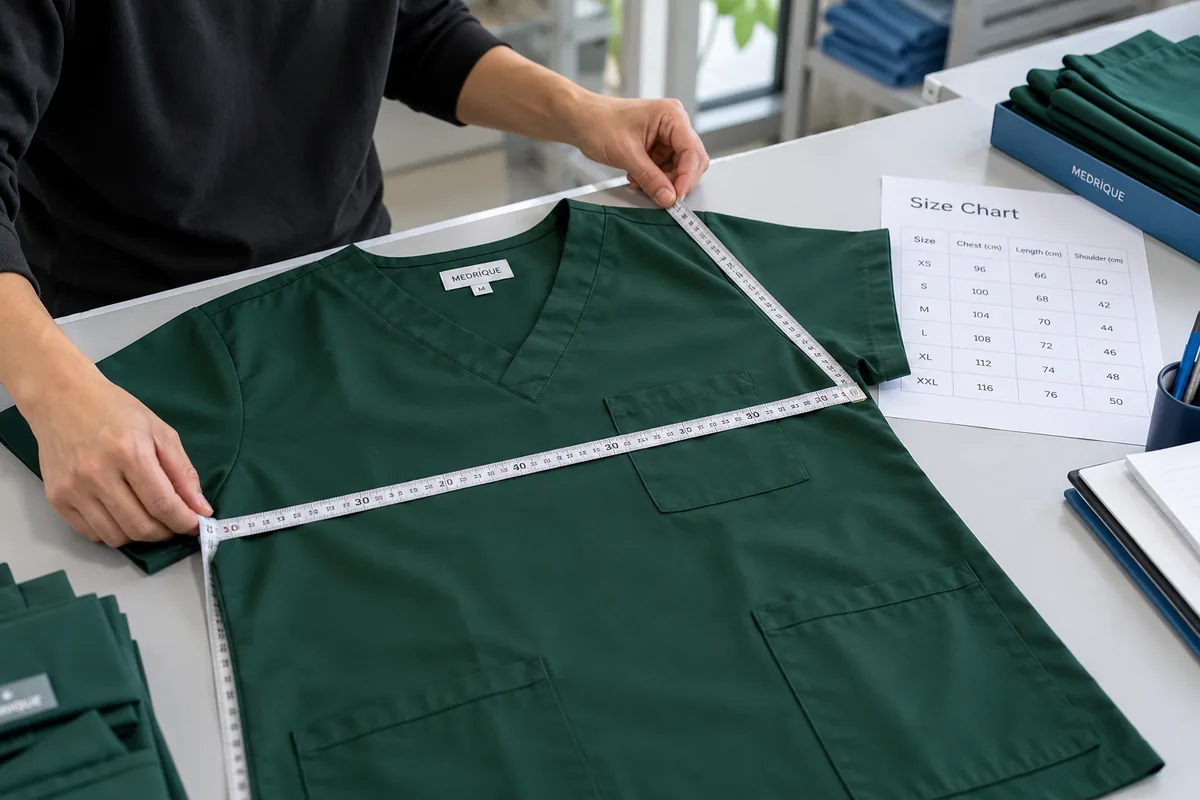
The spec line: a graded size chart with stated tolerances, and separate blocks for petite and tall rather than a scaled base size. Ask explicitly whether extended sizes are graded or scaled — scaling a base block to 4XL produces a garment that is proportionally wrong even when the chest measurement is right. Then require measurement verification at final inspection against that chart.
4. “The pockets are useless”
Listings now advertise six, seven, nine and eleven pockets. Reviews make clear that count is not the complaint. The complaints are specific: a phone pocket that a current phone does not fit, a chest pocket so shallow that pens fall out when you lean forward, a cargo pocket positioned where a seated wearer cannot reach it, and no secure loop for a badge, shears or a monitoring device.
The spec line: specify pocket dimensions and placement in centimetres rather than pocket count, and specify them against the objects they carry. Name the device. “Interior chest pocket, minimum 17cm deep, sized to a large-format phone, with a secured top edge” is a buildable instruction. “Phone pocket” is not.

5. “The embroidery came off in the wash”
This one belongs to you specifically, because it is the complaint that attacks the brand rather than the garment. A logo that lifts, cracks or unravels does not read as a laundry problem to the person wearing it. It reads as a cheap uniform, and if your name is on the chest, it reads as your name on a cheap uniform.
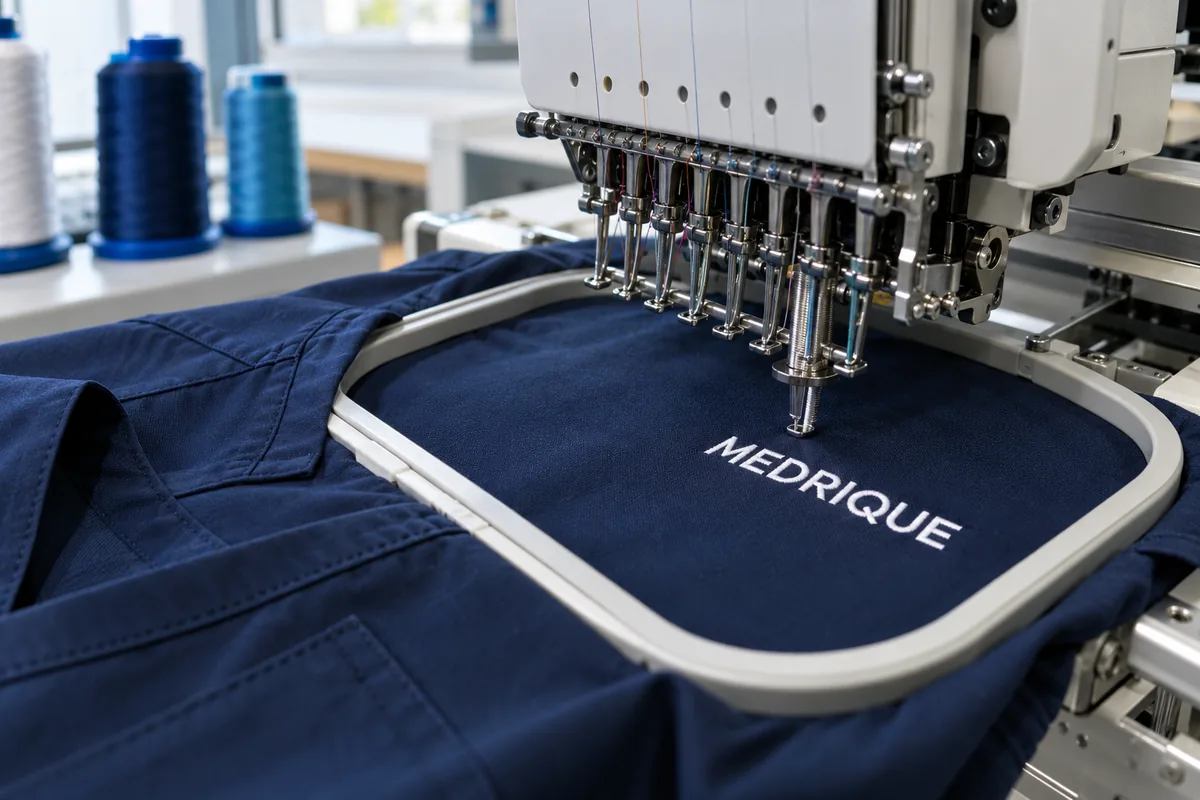
The spec line: require a physical stitch-out or press test approved before any production piece is branded, and specify the method against the laundering the garment will meet. Heat transfer and screen print behave very differently under industrial pressing than under a domestic dryer. Backing, stitch density and underlay all belong in the spec, not in the factory’s discretion. See embroidery and logo branding for how the approval step works.
6. “They faded” — and the version you will meet instead
Wearers complain about fade: black going grey, colours going dull after a few washes. Bulk buyers meet a second version of the same root cause that individuals never see, which is drift. Your reorder arrives a shade off the last one, and now the ward has two generations of uniform standing next to each other.
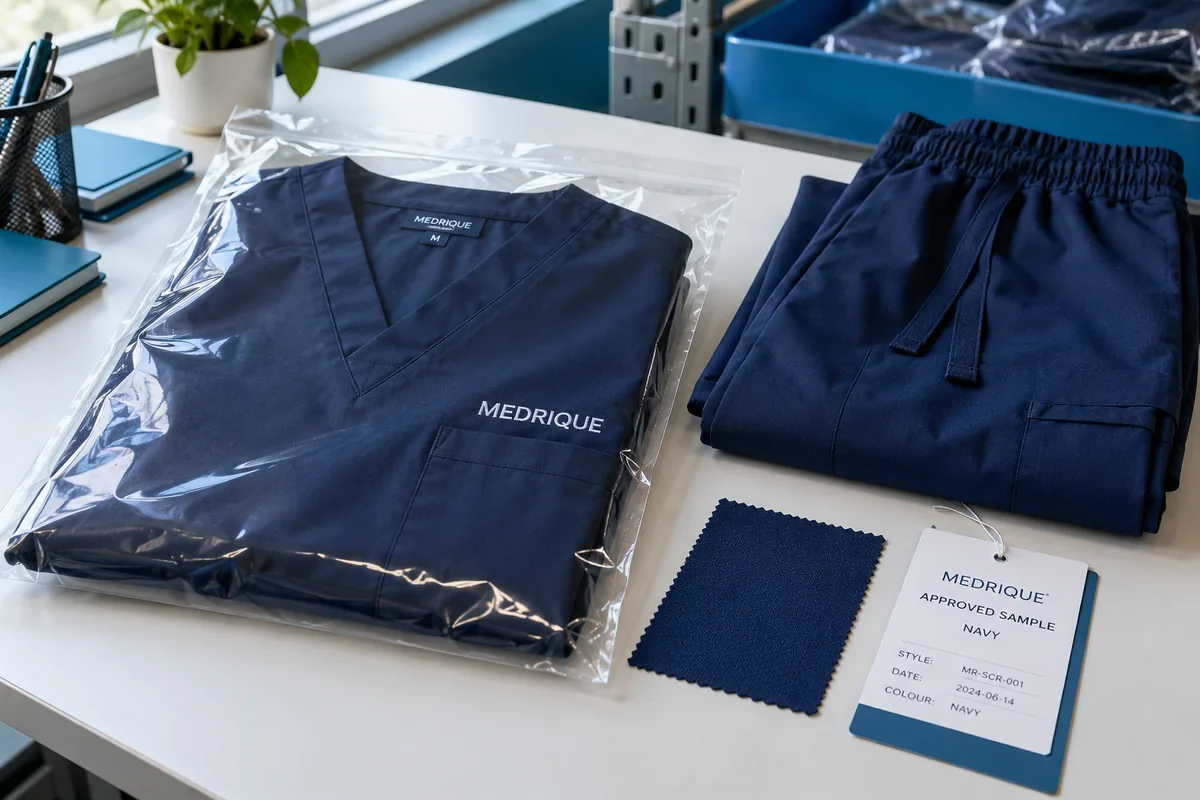
The spec line: fastness grades written into the quote — wash fastness under ISO 105-C06, rubbing fastness under ISO 105-X12 so dye does not transfer onto skin or linen, light fastness under ISO 105-B02. Then, for drift specifically: lab dips approved against a retained physical standard before bulk, dye lot recorded per style, and tops and bottoms in a set cut from the same lot. Match every run to the sealed sample, never to the previous delivery. Matching to the last run is how a colour walks a shade at a time until year three looks nothing like year one. Our guide on matching a mandated scrub colour covers the lab dip sequence.
7. “The seam split”
Reviews describe seam separation at the pocket mouth, the inseam and the underarm. These are the three highest-stress seams on a scrub, and they are frequently sewn to the same specification as a decorative hem.
The spec line: seam slippage resistance under ASTM D434, stitch type and density stated per seam rather than per garment, and bar-tacking at pocket corners and the crotch junction. On stretch knits, add bursting strength under ASTM D3786. If the programme goes through a commercial laundry, also specify skewness under AATCC 179 — that is the test behind pants that rotate on the body after washing.
8. “They run hot and hold the smell”
A consistent complaint about high-polyester performance fabrics: crisp on the rack, and unpleasant by hour seven of a busy shift. Polyester is hydrophobic, which is what makes it dry fast and also what makes it hold odour-causing residue that a cotton-rich blend releases in the wash.
The spec line: match the blend to the environment rather than to the trend. A cotton-rich or poly-cotton construction breathes better for hot wards and long shifts; four-way performance suits mobility-heavy roles in climate-controlled settings. If you are buying for a mixed estate, it is usually better to run two fabrics than one compromise.
9. The fit argument nobody wins
There is a genuine, unresolved split in the wearer community between the slim, tailored silhouette that sells well and the looser cut that a lot of experienced staff openly prefer. Threads asking for a return to relaxed fits attract substantial support. Meanwhile the listings that convert best are the fitted ones.
The spec line: do not pick a side on behalf of your whole wearer base. Carry one block in two fits where volume allows, or choose the fit deliberately against your actual wearers rather than against what photographs well. A low minimum per style is what makes testing both affordable; at a 500-unit minimum you are forced to guess.
A specification block you can paste into an enquiry
Here is the practical output of everything above. Send this with your first enquiry to any supplier. The replies will sort themselves into two piles very quickly: factories that answer line by line, and suppliers who respond with a brochure.
Request for quotation — technical requirements
- Fabric: composition and weight stated under ASTM D3776, for each colour and finish ordered, not as a range-wide figure.
- Pilling: graded under ASTM D3512, grade to be stated in the quotation.
- Shrinkage: dimensional change under AATCC 135, stated in both directions, with the block drafted to allow for it.
- Colour fastness: ISO 105-C06 (wash), ISO 105-X12 (dry and wet rubbing), ISO 105-B02 (light). Grades to be written into the order.
- Colour control: lab dips approved against a retained physical standard before bulk. Dye lot recorded per style. Tops and bottoms of a set cut from one lot.
- Seams: stitch type and density stated per seam. Seam slippage under ASTM D434. Bar-tacks at pocket corners and crotch junction. ASTM D3786 bursting strength on knits.
- Sizing: graded chart with tolerances, XS–5XL. Petite and tall drafted as separate blocks, not scaled. Measurement verification at final inspection.
- Pockets: dimensions and placement in centimetres, specified against the devices carried.
- Branding: physical stitch-out or press test approved before production. Method specified against the laundering cycle.
- Laundering: state the wash temperature, chemistry and press temperature the garment will meet in service.
- Inspection: AQL sampling at final gate, plus a pre-shipment sample checked against the sealed standard.
- Commercial: itemised quote — fabric, cut-make-trim, trims, branding, packing, freight priced separately. FOB and landed. Duty shown as its own line with the HS classification used.
Which complaints matter most for your buyer type
Not every complaint carries the same weight for every buyer. Spend your specification effort where the failure would actually cost you something.
| Buyer | What hurts most | Where to spend the spec effort |
|---|---|---|
| Scrub brand or startup | Branding failure and colour drift — both damage the name rather than the garment | Stitch-out approval, sealed sample, low per-colourway minimum so you can test a range |
| Hospital or clinic buying in bulk | Sizing inconsistency and laundry survival across a large, varied staff | Graded chart with tolerances, AATCC 135 shrinkage, commercial-laundry spec |
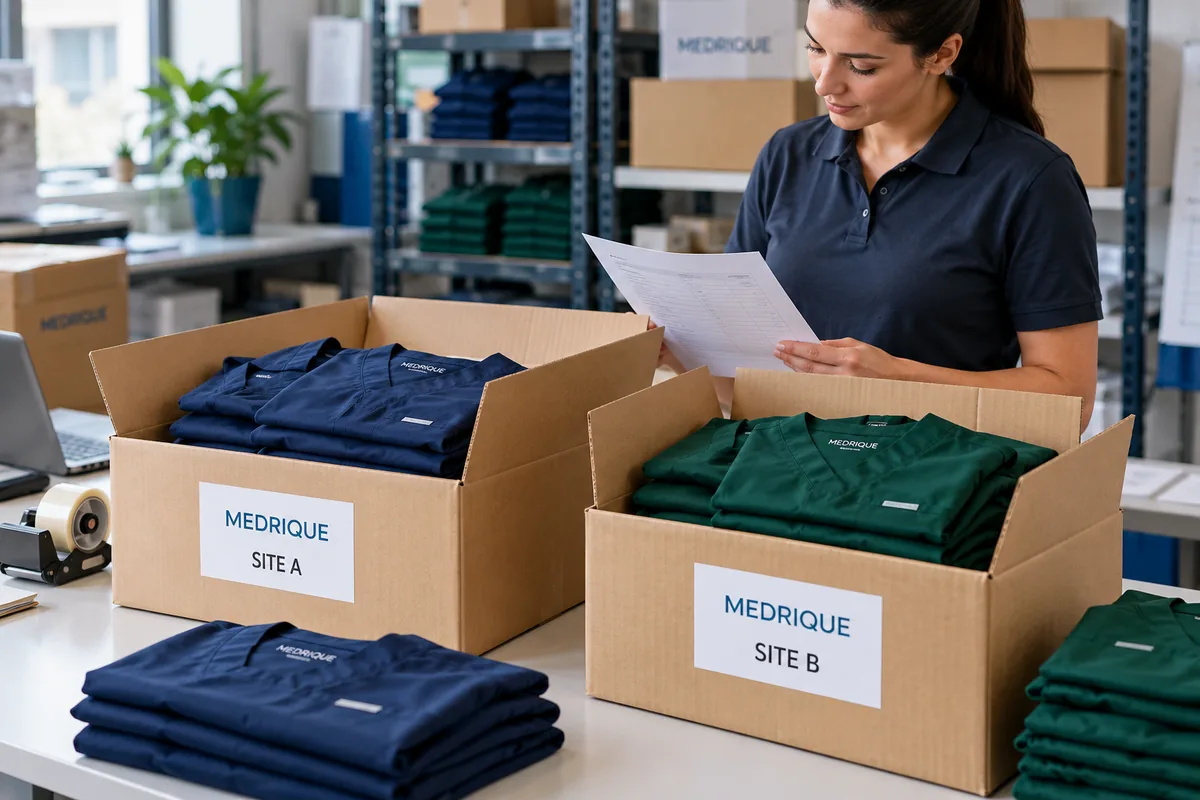
| Uniform distributor or retailer | Shade drift between replenishment orders, and returns driven by fit | Dye lot control, retained standard, documented size chart you can publish |
| Dental, veterinary or aesthetic practice | Appearance under close client contact: fade, pilling, visible wear | Pilling grade, fastness grades, heavier weight on dark colours |
| EMS and high-exertion roles | Seam failure, pocket security, heat retention | Seam slippage and bar-tacking, secured pocket closures, breathable blend |
What this does to your minimums and your budget
Specifying properly does not automatically make a garment more expensive. Most of what is listed above costs nothing to request — it costs a supplier something to ignore, which is why some will push back on it. Where there is a genuine cost, it is usually fabric weight and stitch density, and both are small per unit against the cost of a programme that has to be replaced early.
The bigger budget variable is the minimum. Published industry guidance for custom production commonly lands around 500 pieces or sets per style with a per-colour minimum near 100, plus a sample fee in the region of US$100 per style. Three styles in three colours at those numbers is several thousand units committed before you have sold or issued a single garment. That is the real reason so many new scrub ranges launch in one colour and never look like a range.
There is a second pressure worth planning around. In the annual benchmarking study run by the United States Fashion Industry Association with the University of Delaware, trade policy uncertainty was named the leading concern by 92% of decision-makers surveyed, with the average customs duty on US clothing imports reported at 21.6% in May against 15.2% in January, raising sourcing costs for 73.7% of the companies surveyed. For a bulk buyer the practical consequence is not panic, it is arithmetic: when landed cost per unit rises, holding a large quantity of stock ties up more capital than it did a few years ago, which makes smaller and more frequent runs more defensible than they used to be. Our guide to reading a factory cost breakdown covers how to get duty onto the quote as its own line.
Frequently asked questions
What is the minimum order quantity for custom medical scrubs?
It varies enormously. Published guidance for custom production often cites around 500 pieces or sets per style with a per-colour minimum near 100. Lower minimums exist: Medrique produces from 30 units per style. The number that actually constrains a range is the per-colourway minimum, and it is the one least often published, so ask for it in writing before you plan a colour range.
How do I stop bulk scrubs arriving a different shade from my last order?
Require a sealed physical sample to be retained and matched on every run, lab dips approved against that standard before bulk dyeing, and the dye lot recorded per style. Match each run to the sealed sample rather than to the previous delivery — matching to the last run lets the colour drift a shade at a time.
What fabric weight should I specify for bulk medical scrubs?
Around 160–190 GSM suits most everyday tops and pants. Step up to roughly 190–220 GSM for whites, for dark bottoms and for any programme going through commercial laundry. Always have the weight quoted for the specific colour and finish you are ordering, because dye and finish both change the figure.
Why do scrubs pill, and can I specify against it?
Pilling comes from fibre, yarn and finish rather than from bad luck, and it is measurable. Ask for a grade under ASTM D3512, the random tumble pilling test, on a 1 to 5 scale where 5 means no pilling. A supplier who cannot state a grade has not tested the fabric.
How do I make sure embroidered logos survive industrial washing?
Approve a physical stitch-out or press test before any production piece is branded, and specify the branding method against the actual laundering cycle. Backing, stitch density and underlay should be in the specification. Heat transfer and screen print behave very differently under heated industrial pressing than under a domestic dryer.
Is it cheaper to buy wholesale stock scrubs or produce custom ones?
Stock wholesale has a lower entry cost and no development time, and it is the right answer if you need generic garments quickly. Custom production costs more up front and gives you control over fabric, fit, colour and branding, plus a sealed standard for consistent reordering. The deciding question is usually whether the garment carries your name — if it does, the consistency controls are worth paying for.
What documents should I send a scrub manufacturer to get an accurate quote?
Quantities by style, colour and size curve; fabric composition and weight; a colour reference; pocket dimensions and placement; branding artwork with placement; your laundering conditions; and your delivery destination. If you have a garment you already like, send it annotated — a marked-up physical sample is worth more than several pages of description. Our tech pack checklist sets out the full list.
Where this fits, and what to read next
Every specification line above is something we hold ourselves to. Our custom medical scrubs manufacturing overview sets out the process behind them.
- Compression socks for nurses — What the mmHg number actually does across a twelve hour shift, and why fit matters more.
- Private label scrub socks: the spec sheet — Needle count, yarn, toe closure and claim wording before you order a sample.
- Black scrubs for women — What they mean, who wears them, and how to choose a pair that stays black.
- Scrub fabric weight explained — What GSM actually changes, and why one figure across a whole range is an average.
- MOQ per style versus per colourway — The minimum most factories do not publish, and the one that decides your colour range.
- How to read a factory cost breakdown — What an itemised quote contains, FOB versus landed, and where duty belongs.
- Matching a mandated scrub colour — Lab dips, retained standards, and holding one shade across every reorder.
- Will these survive commercial laundry? — The test methods to name when garments go through industrial washing.
- A tech pack checklist for your first run — The fields that decide whether bulk production matches your sample.
Bring this list to us
Send the specification block above with your quantities. You get an itemised quote and a production timeline within one business day, with every grade and tolerance written in before you commit.