
Socks look like the simplest thing a scrub brand can add. They are small, cheap per unit, sell in multipacks, and every supplier you contact will say yes to everything on your list. That last part is the problem. A sock quote is easy to get and almost impossible to compare, because the variables that decide whether the product is any good are rarely in the quote at all.
Two socks made from the same fibre, at the same weight, in the same colour, can be completely different products. One is knitted at 96 needles with a bulky toe seam and elastic dropped in at intervals. The other is knitted at 168, closed with a flat linked toe, with the elastane laid in continuously. Both will be described as a cotton blend crew sock. Only one of them will survive a review section.
The short answer
Six specification lines decide the quality of a sock: knitting gauge (needle count), yarn and fibre grade, toe closure method, heel and cuff construction, how the elastane is integrated, and, for compression, the pressure profile and the size curve it is graded against.
Add two commercial lines that decide whether the launch works: your minimum order per colourway rather than per style, and the claim wording on the packaging, which in the United States determines how compression hosiery is treated under 21 CFR 880.5780.
- Why socks are the easiest line extension
- Knitting gauge and needle count
- Yarn: where quality actually comes from
- Toe, heel and cuff
- If it is a compression sock
- Claims, labels and the regulatory line
- Minimums, colourways and cost drivers
- Pack formats and branding
- A spec block you can paste into an enquiry
- Frequently asked questions
Why socks are the easiest line extension
Every garment in a scrub range has a replacement cycle, and socks have the shortest one. A scrub top is replaced when it fades or the brand changes. A compression sock is finished in three to six months of regular wear, because compression is elastane under load and elastane relaxes. That is not a defect; it is the mechanism. It also means the same customer comes back two to four times a year.
Socks also sell in multiples. Nobody buys one pair, which is why the category standardised on 2-, 3- and 6-packs, and why socks raise average order value more reliably than any other accessory at a scrub checkout. Development cost is low, tooling is nil, and the minimums are usually the lowest in an apparel range.
The catch is that socks are judged fast and publicly. A scrub top gets a few weeks of grace. A sock that pills, slides down or presses a seam into a toe inside a closed clog gets a one-star review within a fortnight.
Knitting gauge and needle count
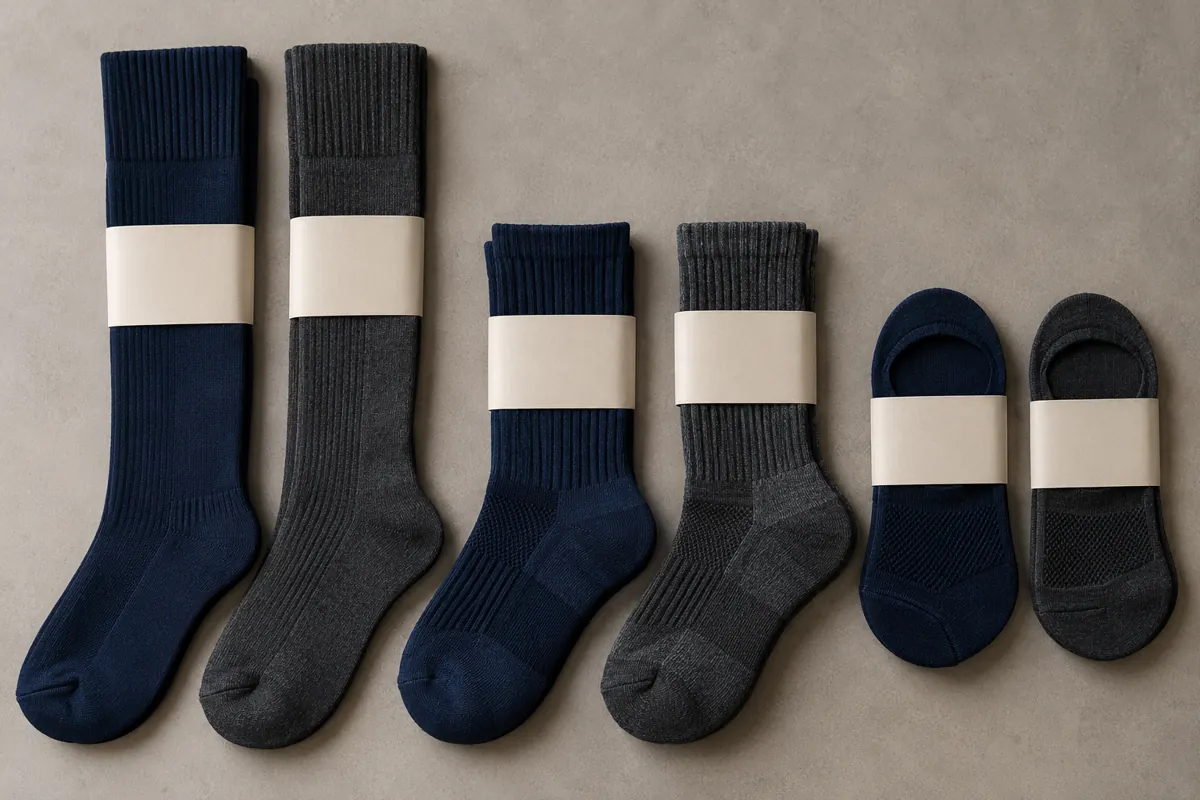
Socks are knitted on circular machines, and the number of needles around the cylinder sets how fine the fabric is. This is the first thing to fix in a specification, because it constrains everything downstream: pattern detail, cushioning, hand feel, and the cost per pair.
| Needle count | Fabric character | Where it belongs in a scrub range |
|---|---|---|
| 84–108N | Thick, lofty, coarse | Heavy work and outdoor socks. Too bulky for clinical footwear. |
| 144N | Standard gauge, holds terry cushioning well | The workhorse for cushioned everyday crew socks. |
| 168–176N | Finer, smoother, moderate cushion | The mid-premium sweet spot. Good for compression and for logo definition. |
| 200N | Fine, silky, thin | Dress-weight and high-definition logos. Runs slower and costs more, and cannot hold chunky cushioning. |
Two mistakes recur. The first is specifying a high needle count because it sounds premium, then asking for a thick cushioned sole, which that gauge cannot produce well. The second is judging needle count in isolation. A 144-needle sock in long-staple combed cotton with a linked toe and proper reinforcement will outperform a 200-needle sock in commodity yarn with a bulky toe seam every time.
Yarn: where quality actually comes from
Pilling is the complaint that ends sock listings, and it is a yarn problem before it is a knitting problem. Short-staple yarn sheds fibre ends that tangle into pills at friction points. Combed, long-staple yarn does not, or does so far more slowly. If one line in your specification is going to be fought over on price, make it this one.
The usable options for medical workwear:
Nylon and elastane. The pressure-bearing platform for anything compressive. Durable, recovers well, and the only sensible base for a sock that has to hold a pressure figure.
Combed cotton and poly-cotton. The comfort end of a range. Breathable, familiar, and the format most buyers expect in a multipack.
Merino, bamboo viscose and modal. Premium positioning and odour performance. These are the fibres people notice when they open the pack, and they justify a higher shelf price in a category where differentiation is hard.
Finishes. Antimicrobial and moisture-management treatments matter more in closed clinical footwear than in almost any other application. Specify the finish, and specify how many washes it is rated to survive, because an untested finish is a marketing claim with a short life. The same principle we apply to fabric weight in scrubs applies here: a number with no test method behind it is decoration.
Toe, heel and cuff
Three construction details carry most of the comfort, and all three are invisible in a photograph.
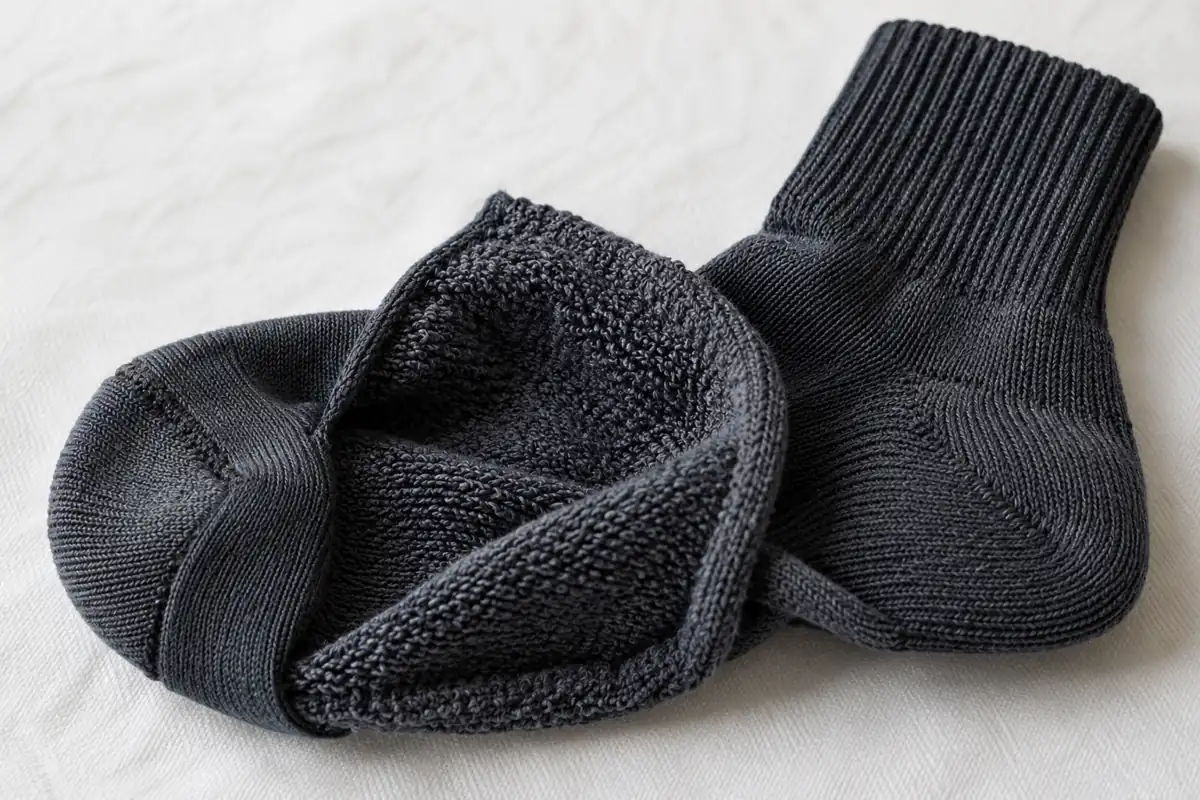
The toe closure. A hand-linked or flat closure loops the stitches together to leave a seam with no raised ridge. The alternative leaves a bump that sits directly against the toes. In a dress sock this is a preference. In a compression sock inside a clog worn for twelve hours it is the single most common source of complaints, because the compression presses the seam into the foot rather than letting it float. Name the closure method explicitly in writing.
The heel. Y-heel shaping and a reinforced high-splice put extra yarn where the sock is abraded by the shoe. Reinforcement at the heel and toe extends usable life more than raising the gauge does.
The cuff. Most complaints about socks cutting into a calf are complaints about the welt, not about compression class. A deep non-roll welt knitted with its own elastane specification holds position without leaving a ring; a narrow band of strong elastic does the opposite. Specify welt depth and welt elastane separately from the leg.
If it is a compression sock
Compression adds three specification lines that a normal sock does not need.
The pressure profile. State the mmHg range and state where it is measured. Graduated socks carry the highest pressure at the ankle. Progressive socks carry it at the calf, and in a study on healthy volunteers that profile proved easier to put on, slightly more comfortable, and significantly more effective at reducing occupational swelling. For a workwear sock that is a genuine option rather than a curiosity. We cover the pressure classes in detail in our guide to compression socks for nurses.
The size curve. Compression is produced by fabric stretched over a limb, so the pressure on the label is conditional on fit. Grade to calf circumference, not shoe size, and include wide and extra-wide blocks rather than telling larger customers to size up. Mis-sizing in compression hosiery is common enough to have been measured: one study reported in the American Journal of Nursing found stockings incorrectly sized in just under thirty per cent of cases examined.
Retention after washing. Ask for compression retention to be verified against a sealed sample after a stated number of wash cycles at your real laundering temperature. Without that line, the sock is only guaranteed to hold its pressure on the day it leaves the factory.
Claims, labels and the regulatory line
This is the part most first-time sock brands discover late, usually after artwork has been approved.
In the United States, compression hosiery is addressed by 21 CFR 880.5780, which distinguishes between a medical support stocking for general medical purposes and one intended to prevent the pooling of blood in the legs. Those two descriptions carry different classifications and different obligations. Anti-embolism stockings sold to prevent deep vein thrombosis sit further along the same spectrum again, and products in that space have gone through FDA premarket submissions.
The practical consequence is simple: your packaging copy, not your knitting machine, decides which bucket you land in. A sock sold for leg fatigue, comfort and everyday support during long shifts is a different regulatory proposition from one whose box claims it prevents blood pooling or DVT. The wording is a decision to make deliberately, at the start, with your own regulatory advisor reviewing the final copy before it goes to print.
Minimums, colourways and cost drivers
The minimum that matters is almost never the one quoted first. Suppliers publish a minimum per style, because it is the flattering number. The one that constrains a launch is the minimum per colourway, because it decides how many colours you can actually put on a shelf. Six colours at a 300-pair colourway minimum is an eighteen hundred pair order, whatever the headline per-style figure says. We wrote about this specifically for scrubs in MOQ per style versus per colourway, and the arithmetic is identical for socks.
What actually moves the cost per pair:
| Driver | Effect on cost | Worth paying for? |
|---|---|---|
| Needle count | Finer gauges run slower, so cost per pair rises | Only if the product needs fine detail or a slim profile |
| Yarn grade | Combed long-staple costs more than commodity yarn | Yes. This is the pilling line |
| Toe closure | Linked and flat closures add finishing time | Yes for compression and clinical footwear |
| Terry cushioning | More yarn, slower knitting | Depends on positioning; half cushion is often the right compromise |
| Number of colours | Each colourway carries its own minimum and setup | Launch narrow, widen on reorder data |
| Knit-in branding | Minor cost, significant durability gain over print | Yes |
Pack formats and branding
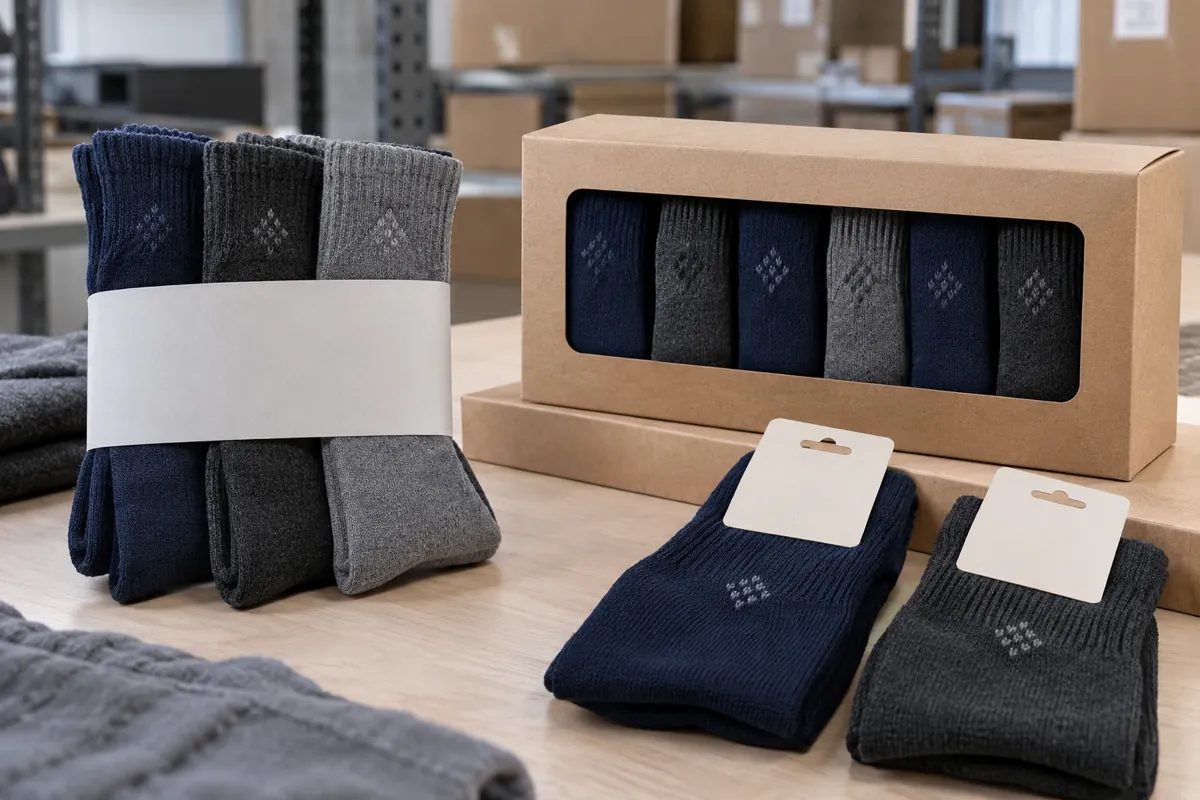
Socks are a packaging product as much as a knitted one. The format decides the shelf price and the order value, and 2-, 3- and 6-packs are the formats the category has settled on for good reason.
On branding, knit-in logos and jacquard marks belong in the cuff or the leg, where they are part of the fabric rather than sitting on top of it. Printed branding on a sock has a short life under repeated washing. Woven labels, header cards, hangtags and printed size and pressure markings on the cuff are all straightforward. If the socks are going out alongside a scrub range, match them to the same approved colour standards so the bundle reads as one system rather than two purchases, exactly as we do across private label scrub production.
A spec block you can paste into an enquiry
Send this with your quantities
- Product type: cushioned crew / compression knee-high / compression crew / no-show / over-the-calf
- Knitting gauge: state needle count, or state the outcome you want and let the factory recommend it
- Yarn: fibre blend, and combed long-staple specified where cotton is used
- Sole structure: flat / half cushion / heel-and-toe / full terry
- Toe closure: hand-linked or flat closure, named explicitly
- Heel: Y-heel shaping and reinforced high-splice
- Cuff: welt depth and welt elastane specified separately from the leg, non-roll required
- Compression (if applicable): mmHg range, measurement point, graduated or progressive profile
- Size curve: calf circumference bands including wide and extra-wide, with foot length graded separately
- Testing: compression retention and cuff recovery after a stated number of wash cycles at your laundering temperature
- Colour: approved colour standards, one dye lot per bulk run, matched to your scrub palette
- Branding: knit-in logo placement, woven label, hangtag, cuff printing
- Packaging: pack count, header card, hanging hook, carton format
- Claim wording: final packaging copy, reviewed before artwork
- Minimums: ask for both per style and per colourway, in writing
A supplier who can answer every line of that without hedging is a supplier worth sampling with. One who answers by sending a price per pair has told you something useful too.
Frequently asked questions
What is the minimum order for private label socks?
Socks generally carry among the lowest minimums in an apparel range, which is why they work as a first product or a line extension. The figure that matters is the minimum per colourway rather than per style, because that is what limits how many colours you can launch. Ask for both numbers in writing before you plan a range.
What needle count should I choose for a medical sock?
144N is the standard for cushioned everyday crew socks and holds terry well. 168N is the common choice for compression and for crisper logo definition. 200N produces a fine, thin dress-weight sock and cannot carry heavy cushioning. Needle count should follow the product, not the other way round.
Why do socks pill, and can I specify against it?
Pilling comes mainly from short-staple yarn shedding fibre ends at friction points. Specify combed, long-staple yarn, and ask for the pilling grade of the proposed construction. A supplier who cannot state one has not tested the fabric.
Do I need FDA clearance to sell compression socks?
It depends on the claims. Compression hosiery is addressed by 21 CFR 880.5780, which separates stockings for general medical purposes from those claiming to prevent pooling of blood in the legs, with different regulatory treatment attached. Positioning a sock for comfort and leg fatigue is a different proposition from claiming a medical effect. Have your regulatory advisor review final packaging copy.
Should my first sock be compression or a regular knit?
Most brands launch with both: a cushioned crew for volume and one graduated knee-high to carry the compression story and the better margin. Widening the colour range on the proven style usually beats adding a third style early.
How do I make sure reorders match the first run?
Keep a sealed physical sample and match every subsequent run against it rather than against the previous delivery, which is how colour and fit drift a little at a time. Record the dye lot, and have measurements and compression retention audited against the sealed standard on each run.
Where this fits, and what to read next
We manufacture custom wholesale scrub socks to the specification above, in compression and everyday knits, for scrub brands, uniform distributors and health systems.
- Compression socks for nurses: what mmHg actually does — The pressure research, and why fit matters more than the number.
- A tech pack checklist for your first production run — The fields that decide whether bulk matches your sample.
- How to read a factory cost breakdown — What an itemised quote contains, and where duty belongs.
- Buying medical scrubs in bulk — Nine complaints from real reviews, and the spec lines that prevent them.
- MOQs, sampling and lead times — What our minimums are and how sampling runs.
Send us the spec block
Paste the specification above with your quantities and colour range. You get an itemised quote and a production timeline within one business day, with minimums quoted per style and per colourway.