Shop by colour

Black scrubs

The most requested colour in private practice and aesthetics, and the one where fabric quality shows fastest.

  • 30-unit minimum per style
  • Itemised quote in 1 business day
  • Sealed sample kept for every reorder
  • Graded XS to 5XL, petite and tall
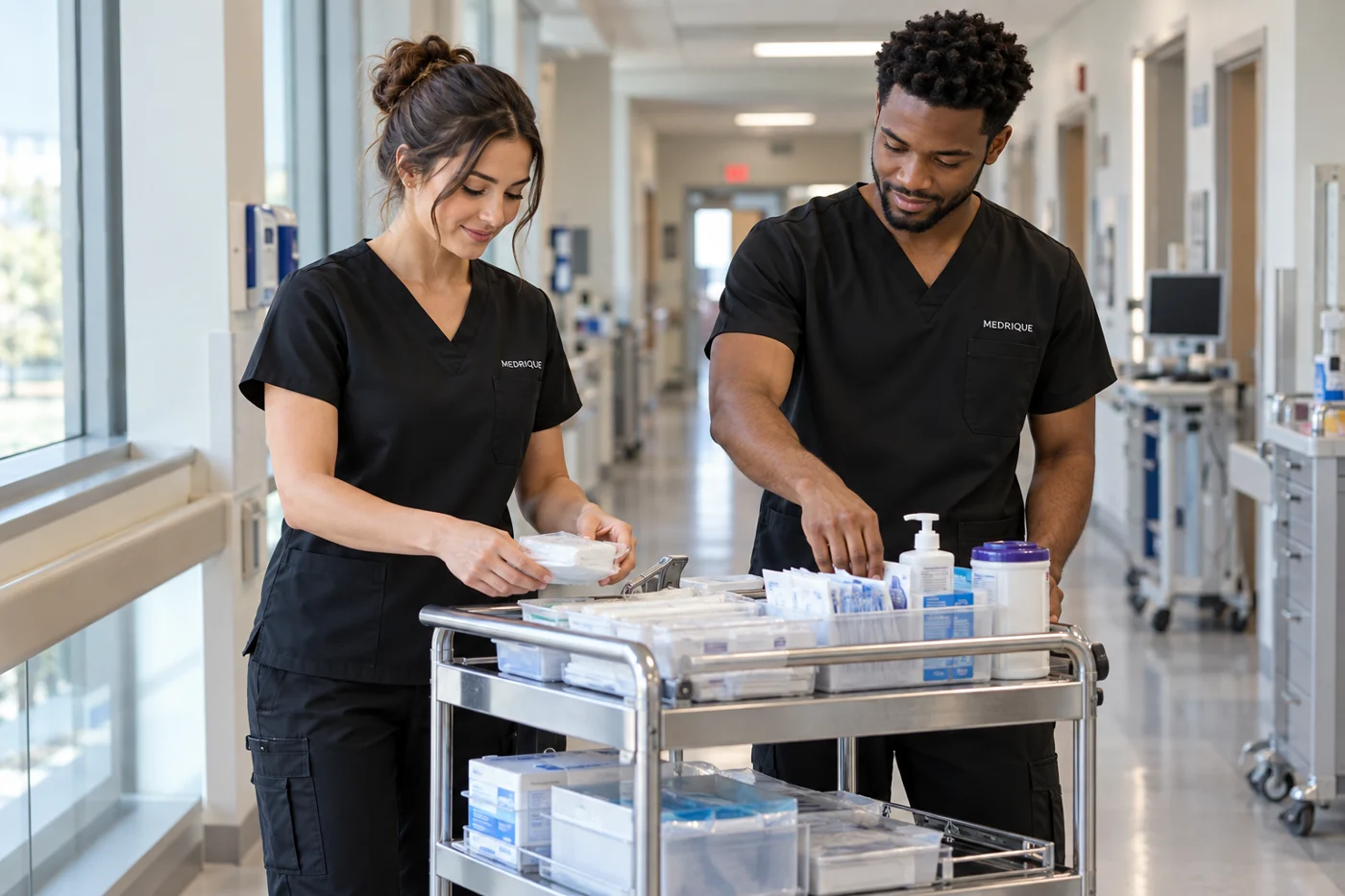
Clinical team wearing black Medrique scrub sets

Black is the least forgiving colour in medical apparel

It looks sharp on day one and it is the colour where cheap fabric gives itself away soonest. Black fades toward grey and brown under repeated laundering, shows lint and animal hair from a distance, and any inconsistency between dye lots is immediately visible.

Which is why black is a good test of a supplier. Holding a true black across repeat orders requires a retained standard and a controlled dye process, not a colour code on a purchase order.

Black is usually specified in stretch fabrics for depth of colour, and sits in the same colour programme as hunter green and blue.

Not sure black is right for your setting?Send us the setting, the laundry regime and the dress code. We will tell you honestly whether black will hold up before you commit a budget to it.
Ask us first

Black scrubs for women, men and mixed teams

Black is the colour that exposes a bad pattern block. A shoulder seam sitting half an inch out, a top pulling across the chest, a waistband that rolls at the end of a shift: on a dark garment these read as shadow and broken line, and the eye finds them immediately. On a print or a mid-tone they largely disappear. So if a team is moving into black, the fit has to be settled before the colour is.

Woman wearing a black V-neck scrub top and matching pants
Women's block
  • ShoulderNarrower with more slope, so the seam sits on the joint instead of past it
  • Waist & hipShaped through the body, with hip room built in rather than borrowed from a larger size
  • SeamingPrincess seams, which hold their line on black where a single dart reads as a crease
  • Best forTeams in the same garment daily, where fit complaints surface within weeks
Man wearing a black Medrique V-neck scrub top
Men's block
  • ShoulderBroader, with a straighter side seam running through the body
  • LengthLonger body, so the hem stays down when reaching overhead rather than riding up
  • Rise & inseamGraded for height rather than waist alone, with a tall option held on the same block
  • Best forMixed-height teams where a single inseam has already caused complaints
Clinical team wearing black Medrique scrub sets
Unisex block
  • CutOne straight body, sized rather than shaped, with pocket positions kept neutral
  • SizingGraded XS to 5XL, so a single size curve covers a whole department
  • ReissueBuilt for circulating stock that moves between staff and through central laundry
  • Best forFacilities that launder centrally and reissue garments rather than assigning them
Buying for a mixed team? Order the blocks together, not in sequence. Three different blocks cut from the same approved dye lot still read as one uniform. The same three ordered separately across a few months read as three different blacks standing next to each other, which is the failure people notice first. We quote women's, men's and unisex as a single programme for exactly that reason.
Buying for a mixed team? Quote all three blocks togetherWomen's, men's and unisex cut from one approved dye lot, so they still read as one uniform on the floor rather than three different blacks.
Quote my team

Specification at a glance

We match to Pantone on any colour. The approved lab dip becomes the retained standard, so every future order is matched to a physical reference rather than a code.

ItemWhat we offer
AvailabilityEvery garment and fabric in the range
Colour controlRetained approved standard, matched on every reorder
Watch forFading toward grey, and lint or hair visibility
BrandingTonal embroidery reads well on black
MinimumsPer style and per colourway, both quoted with your enquiry
Get this specced for your teamSend the fabric, colour and quantities you have in mind. You get an itemised quote and a production timeline within one business day.

What goes wrong with black scrubs at scale

Black has three failure modes, and none of them show on the first sample you approve. Two are dye-house problems rather than fabric problems. The third belongs to this colour alone. Together they are the reason a black programme gets replaced early.

1Crocking

Unfixed surface dye rubbing off onto seat covers, patient linen and the inside of white lab coats. It is caused by a skipped reduction clear after dyeing, it is permanent on whatever it marks, and it is completely invisible on the sample you approved.

2Greying

The slow drift from black to charcoal to a dusty brown under repeated hot washing. The garment is not worn out and the seams are fine. It simply no longer matches the black standing next to it on the same corridor.

3Lint

Gauze, blanket fluff and dressing-pack fibre are all pale, so they sit on the surface of a black garment where they would vanish into a mid-tone. Far worse on any brushed or raised face, and a daily complaint in dental and veterinary work.

Teams that switch to black routinely describe replacing garments within months, and the reason is almost never a seam or a pocket. It is that their black no longer matches the black issued to the person standing next to them — the moment a uniform stops reading as a uniform.

Have any of these already happened to you?Send a worn garment in with your enquiry. What your laundry has done to the old black tells us more than any swatch book can.
Get it diagnosed

How we specify black so it stays black

Depth of shade is the easy part. Holding it is the part that has to be bought deliberately, and it costs a little more per garment than most quotes admit.

For poly-cotton and poly-spandex we specify high-temperature disperse dyeing followed by a reduction clear, the after-treatment that strips unfixed surface dye from the fibre. It is the single most commonly skipped step in a cheap black, and skipping it is what produces crocking inside the first ten washes. On cotton-rich constructions we specify reactive dyeing with a full wash-off for the same reason.

The grades we hold are written into your quote before you order, not discovered afterwards: wash fastness to ISO 105-C06, dry and wet rubbing fastness to ISO 105-X12, and light fastness to ISO 105-B02. Pilling is tested separately, because a tighter knit and a higher-twist yarn are what keep pale fibre from anchoring to the surface in the first place.

Chlorine is the one thing no black survives indefinitely. If your facility wipes uniforms down with bleach products, which is common in emergency departments, we will either specify a bleach-tolerant construction or tell you plainly that the shade will shift, and quote a replacement cycle you can budget for. We would rather lose the argument at quotation than at delivery.

Property testedStandard we holdWhy it matters on black
Wash fastnessISO 105-C06Governs how far the shade drifts toward charcoal over repeated laundering
Rubbing fastnessISO 105-X12 (dry & wet)Stops dye marking seat covers, patient linen and white coat facings
Light fastnessISO 105-B02Matters for reception and consulting rooms with strong daylight
PillingTested separatelyA tighter knit and higher-twist yarn stop pale fibre anchoring to the face
Want these grades written into your quote?Wash, rubbing and light fastness stated before you order rather than discovered afterwards, along with the pilling test behind the lint behaviour.
Get an itemised quote

Black across every garment we make

Black does not behave the same way on every piece of a uniform, because each piece is washed at a different frequency, abraded in a different place and seen next to something different. These are the garments we are asked for most in black, and what actually changes when the colour is black rather than anything else.

Man wearing a black Medrique V-neck scrub top

Black scrub tops

The garment lint lands on. Gauze, blanket fluff and dressing-pack fibre are pale and sit at chest and forearm height, where people look. Countered with a tighter knit face and a higher-twist yarn.

Scrub tops ›
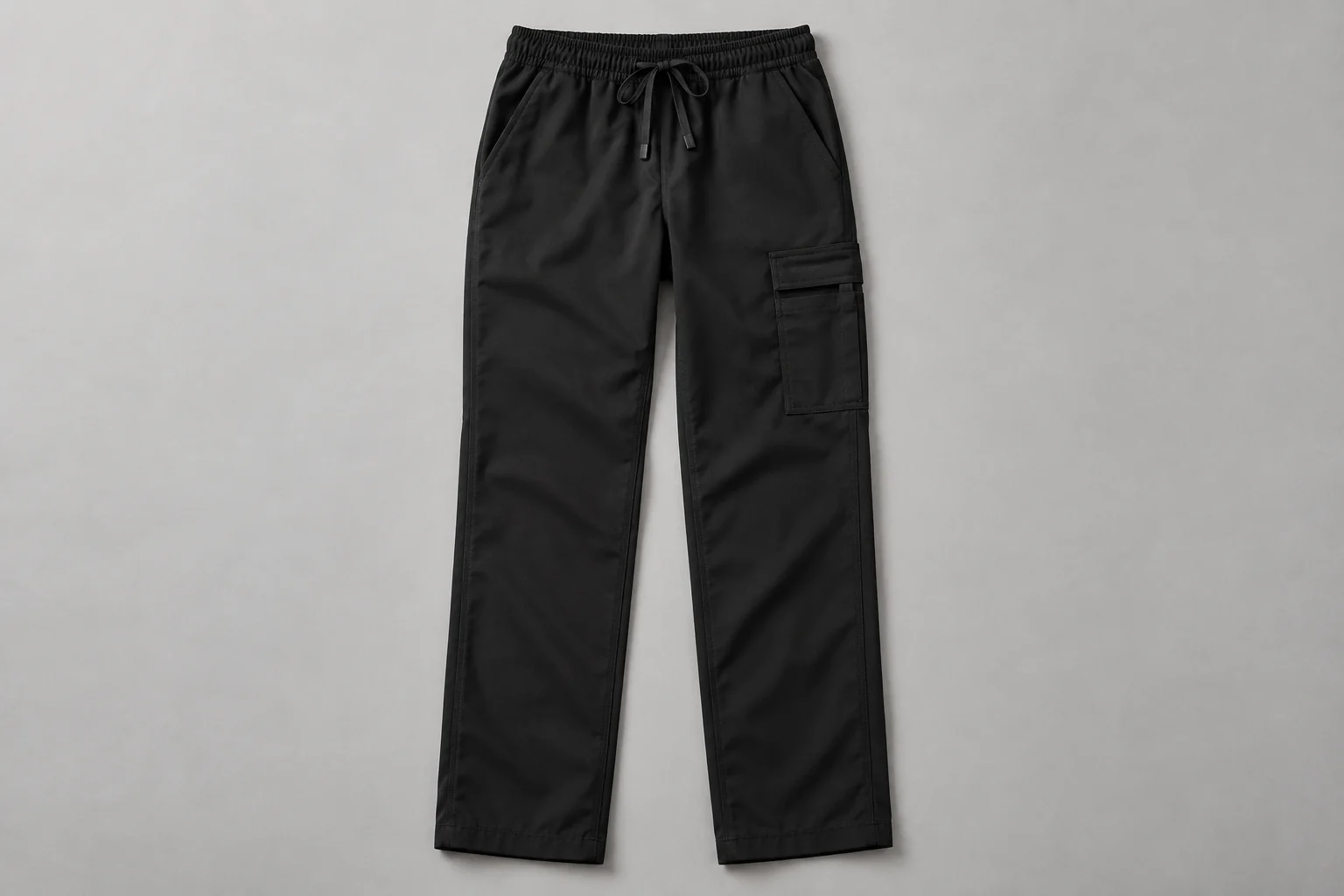
Black scrub pants with practical pockets

Black scrub pants

The most-ordered black garment, because black bottoms are the usual compromise inside a colour-coded facility. Seat, knee and hem take the most abrasion and show unfixed dye first.

Scrub pants ›
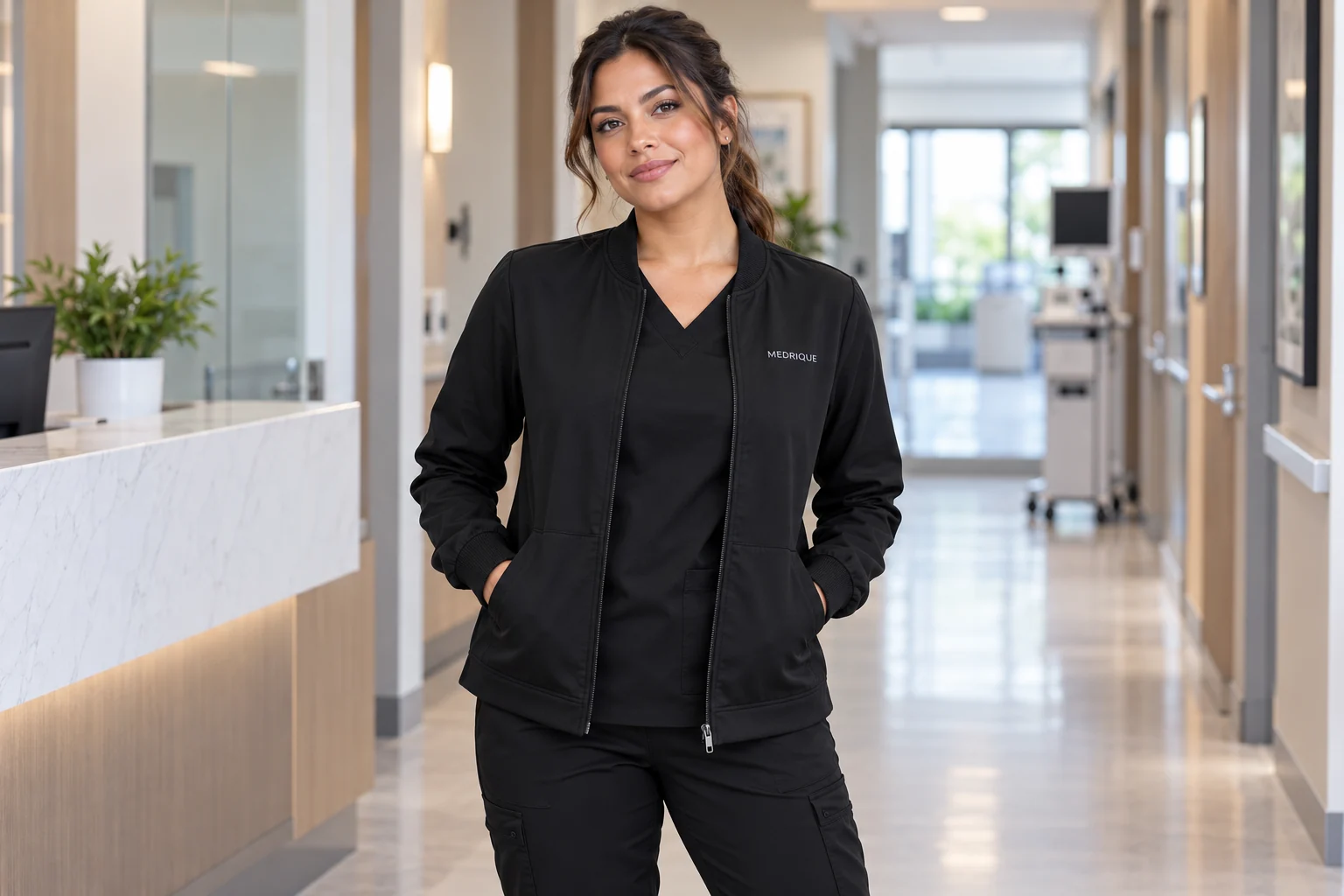
Woman wearing a black V-neck scrub top and matching pants

Black scrub sets

Top and bottom have to come from one dye lot. Bought as separates they are two blacks, and the mismatch shows exactly where they meet at the waist.

Scrub sets ›
Black zip-front scrub warm-up jacket

Black scrub jackets

The layer that quietly drifts out of match, because it is laundered a fraction as often as the top beneath it. A year in, the jacket is the newer black.

Scrub jackets ›
Healthcare professional wearing a white lab coat

Lab coats worn over black

Here the risk runs the other way: a poorly cleared black top crocks onto the inner facing of a white coat, and that mark is permanent.

Lab coats ›
Black long-sleeve underscrub base layer

Black underscrubs

Black under black is the hardest match on this page. Two constructions rarely take dye identically, so specify both together or choose a deliberate contrast.

Underscrubs ›
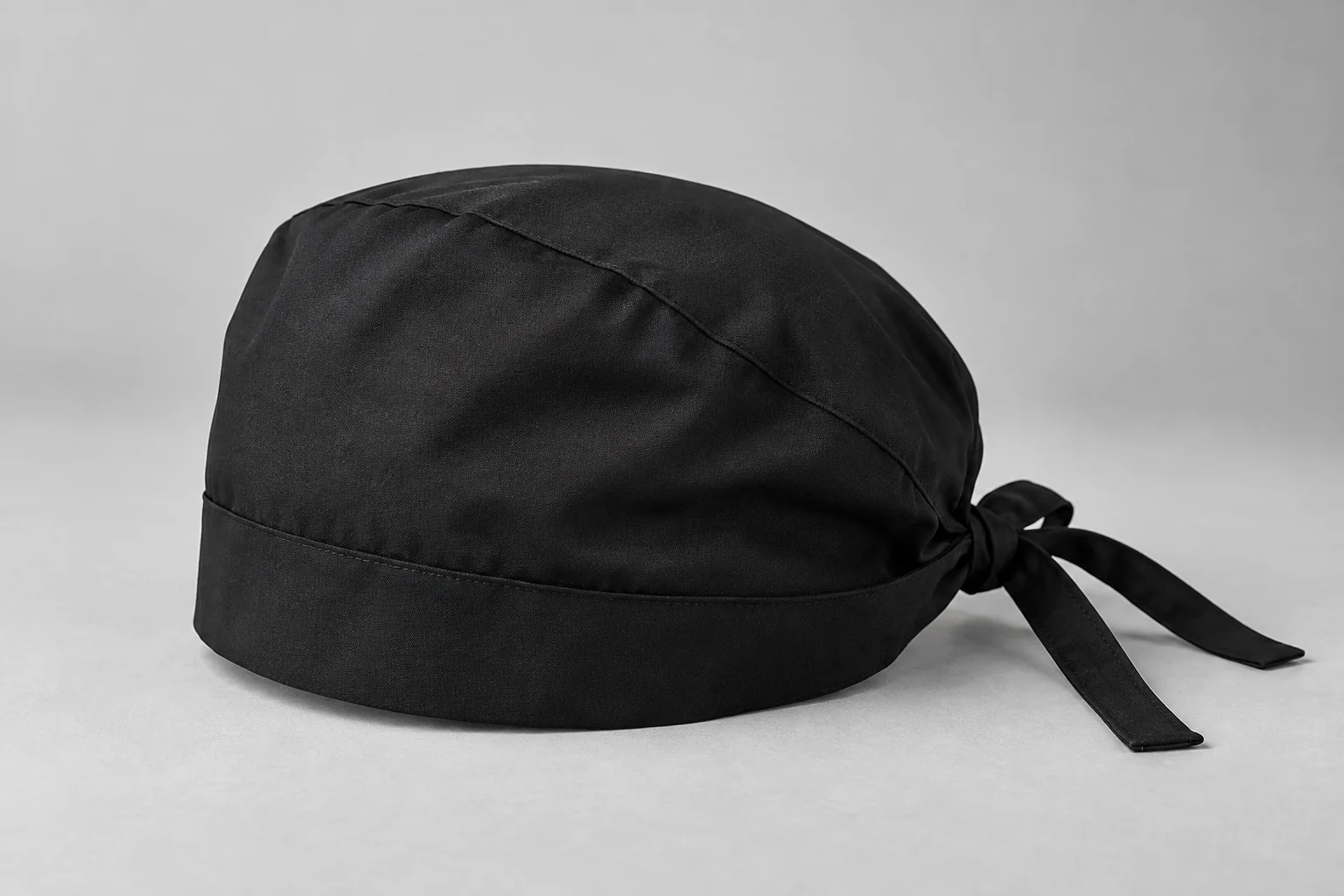
Black scrub cap with Medrique branding

Black scrub caps

Small pieces are the ones cut from remnant stock, which is exactly how a cap ends up half a shade off the set it was bought with. We cut them from the bulk lot.

Scrub caps ›
Send us the garment list and the quantitiesFabric, cut-make-trim, trims, branding, packing and freight priced separately, with a stage-by-stage timeline. Within one business day, from a named person.
Get a free quote

Choosing the fabric that holds your black

The chemistry that fixes black is different for every fibre, which means the fabric you pick decides how your black ages more than the dye house does. Here is what each construction actually does over a year of laundering.

FabricShade stabilityBest forWatch for
Cotton-richLowestBoutique clinics, consulting rooms and domestic laundering, where depth of colour matters more than cycle countGreys fastest under hot institutional washing, because cotton swells and gives up a little dye every cycle
Poly-cottonModerateGeneral wholesale programmes and mixed laundering, and the most common construction we quoteThe cotton half fades first and leaves a heathered cast if the union dyeing was rushed
Poly-spandex Most stableHighestCommercial laundry contracts and high-wear clinical rotations where the shade has to survive the cycleHeat degrades the elastane long before the shade moves, so you lose the stretch first, not the black
Four-way performanceHighPremium own-brand and retail programmes where the garment is photographed and comparedA faint sheen can develop where it abrades at seat and inner arm, reading as a lighter patch rather than fade

Not sure which to specify? Tell us how the garments will actually be washed, at what temperature and with what chemistry, and we will recommend the construction rather than ask you to choose blind. Wash regime decides this more than budget does. See MOQs, sampling and lead times.

Tell us how they will be washed and we will pick the fabricTemperature, chemistry and cycle count decide this far more than budget does. One business day for an itemised, specified answer.
Get a fabric recommendation

Which teams actually choose black

Black concentrates in settings where the brand reads closer to hospitality than to acute care: aesthetic and cosmetic clinics, dental practices, veterinary groups, med spas and private consulting rooms. In those environments the colour does real work, because it photographs well, it reads as expensive, and it does not carry the ward associations that a ceil blue does.

It appears far less often in colour-coded hospitals, where a role-based palette is mandated and black is usually reserved for a support function or excluded altogether. Where a facility wants the look without breaking its own code, the usual compromise is black bottoms under a coded top, and we quote that as a single programme so the two halves are cut from stock bought at the same time.

Ordering black in bulk without shade drift

Two black garments dyed in different lots are two different blacks. That is not a defect, it is how dyeing works, and it is why a uniform programme has to be bought as a programme rather than as a series of repeat orders.

We handle it in three ways. Tops and bottoms that must match are cut from a single dye lot wherever the quantities allow. A sealed reference sample is retained here after your first approval, and every subsequent bulk is assessed against that physical sample rather than against a screen. And where a rollout is staged across months, we will hold fabric from the original lot rather than re-dye later, which is usually cheaper than the alternative once you count the garments you would otherwise scrap.

If you are replacing an existing black uniform, send us a worn garment as well as a new one. The worn piece tells us what your laundry is actually doing to the colour, which is more useful than any swatch.

Rolling out across more than one site?We hold fabric from the original lot so the sites supplied last still match the sites supplied first, which is usually cheaper than a re-dye.
Plan the rollout

Black scrubs by profession

Black is not equally appropriate everywhere, and the reasons it works in one setting are usually the reasons it struggles in another. This is how the colour actually behaves across the sectors we manufacture for, including where we would advise against it.

Clinical team wearing black Medrique scrub sets
Aesthetic and cosmetic clinics

Close to the default here. The room is styled like hospitality and black photographs well under treatment lighting. Pigment and product residue show, so the fabric face matters as much as the shade.

Aesthetic clinics ›
Dental professionals wearing black scrubs in a treatment room
Dentists

Reads clean and modern, and hides the water splash that marks pale tunics by mid-morning. It also collects every fibre off a patient bib, which is why we steer practices to a tight face rather than a brushed one.

Dental practices ›
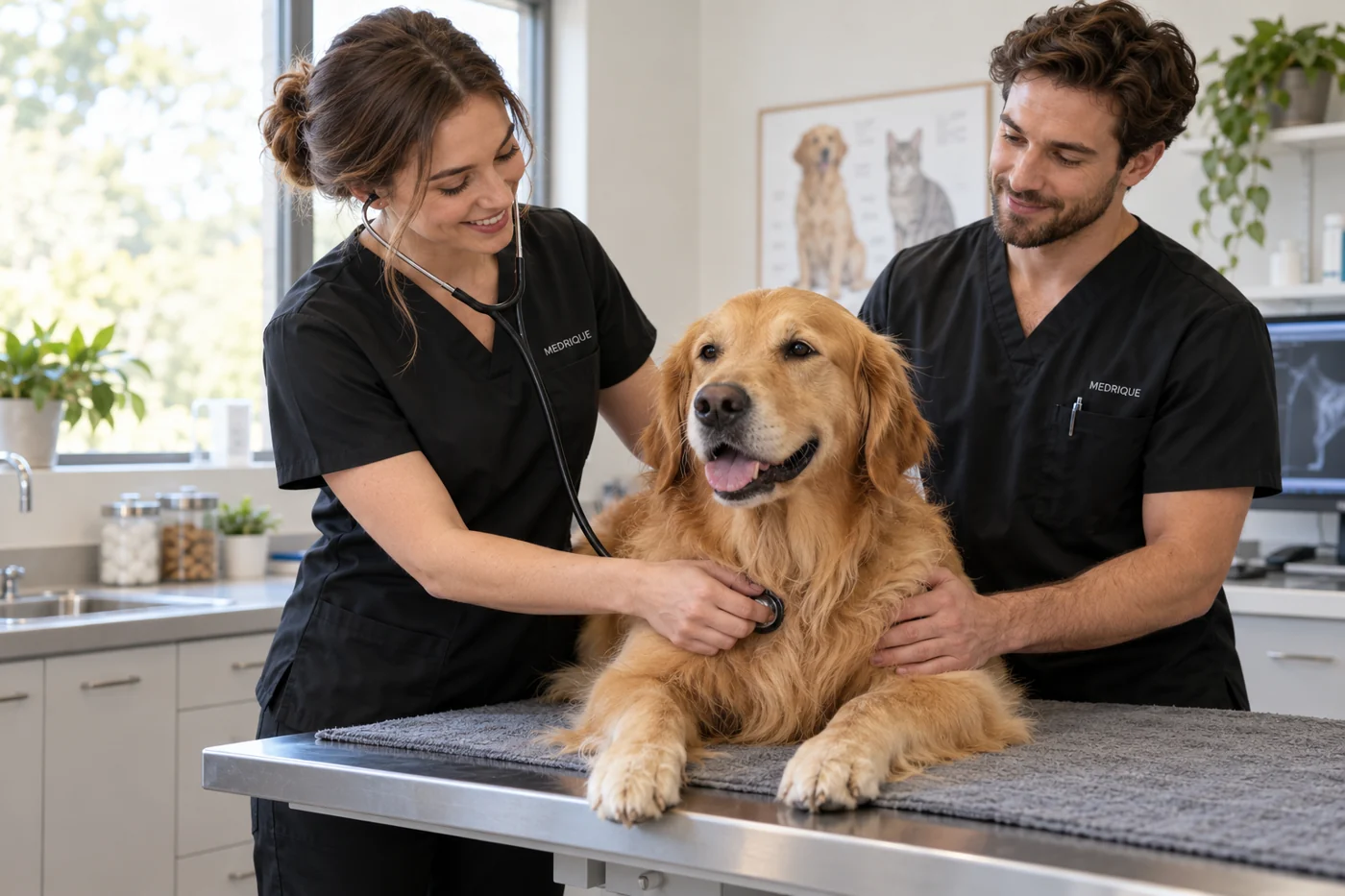
Veterinary professionals wearing black scrubs with an animal patient
Veterinary professionals

The strongest reason to want black and the strongest reason to avoid it. It hides the mess of the work and displays pale animal hair from across a room. Light-coated caseloads often run black bottoms only.

Veterinary teams ›
Hospital professionals wearing black scrub uniforms
Hospitals and clinics

Most colour-coded facilities reserve black for a support function or exclude it, and where the code does allow it black is usually a bottom rather than a top. We read your dress code before quoting.

Hospitals and clinics ›
Emergency medical professionals wearing black uniform scrubs
Emergency medical services

Where black is most likely to shift, because bleach-based wipe-downs are routine and no black survives chlorine indefinitely. We specify a bleach-tolerant construction or quote a replacement cycle you can budget for.

EMS providers ›
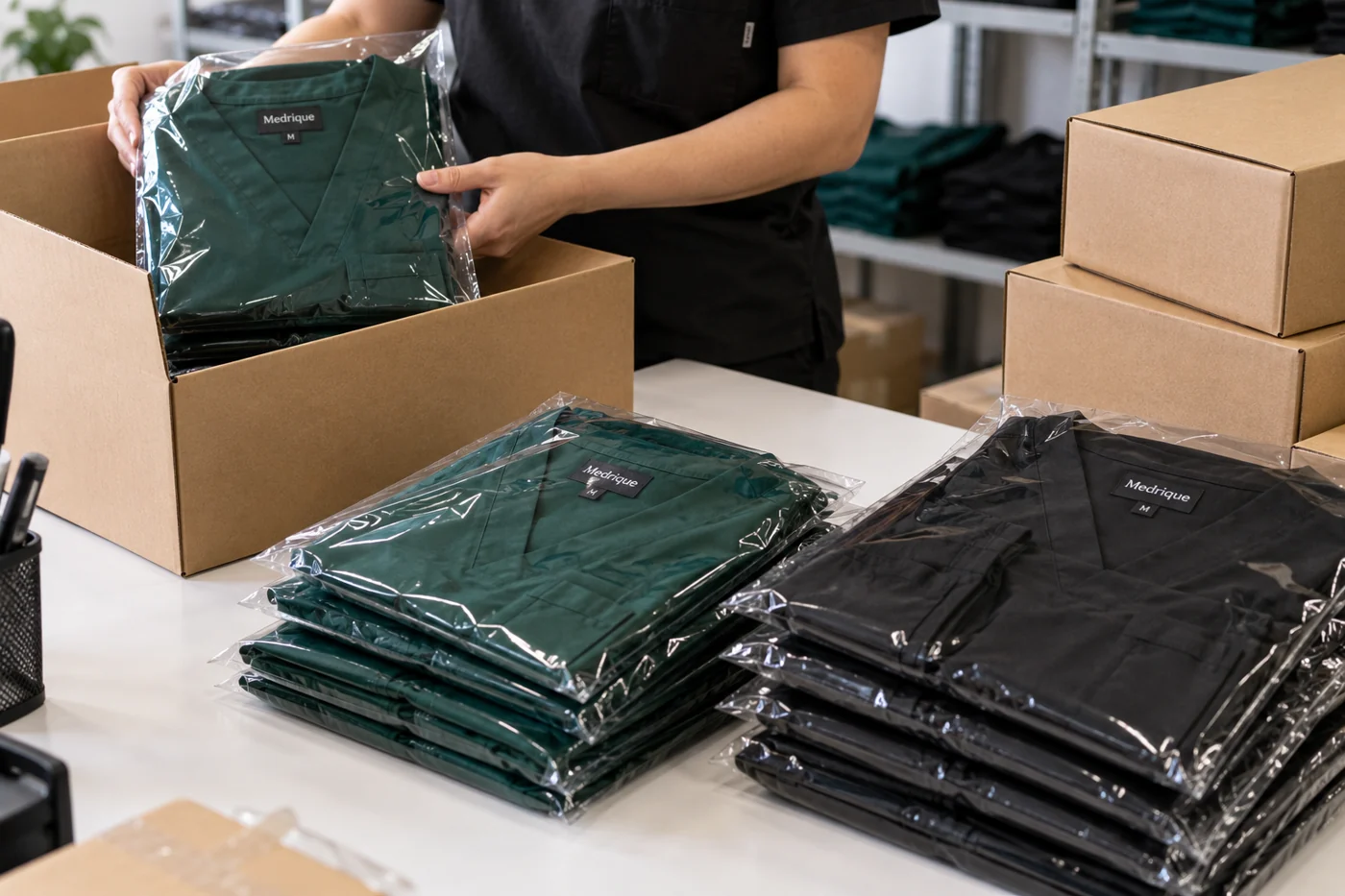
Folded black and hunter green scrubs being packed for shipment
Uniform distributors and retailers

Normally the highest-turning line on a scrub range, which turns shade consistency across restocks into a commercial problem rather than a cosmetic one. A customer reordering one top expects it to match three.

Distributors and retailers ›
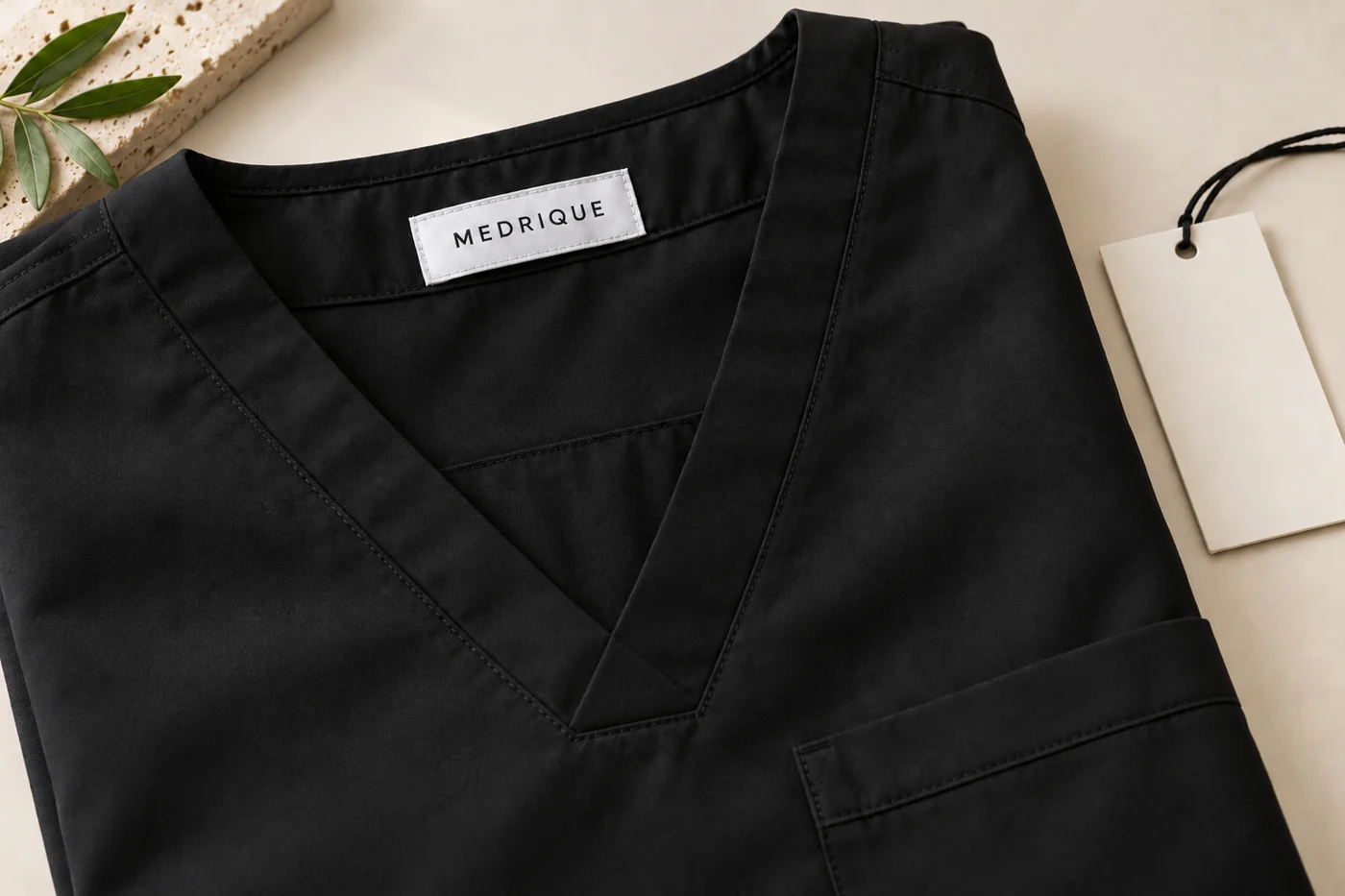
Medrique woven brand label inside a black scrub top
Scrub brands and startups

The colour most brands launch on and the one they can least afford to get wrong, because it is the piece reviewers photograph and compare. Retain the standard at the first order, while a re-dye is still cheap.

Scrub brands ›
Folded black and hunter green scrubs being packed for shipment
Corporate and institutional buyers

Reads corporate, sits beside a logo in almost any palette and photographs well internally. For multi-site rollouts the real risk is staged delivery, where later sites quietly receive a different lot.

Corporate buyers ›
Sitting between two of these? Most black programmes we quote are mixed, with one shade running across clinical, reception and support staff who all need different garments from the same standard. The full list is on who we serve.
Tell us your sector and we will tell you if black fits itIncluding the cases where we would advise against it. Send your dress code with the enquiry and we will read it before quoting, not after.
Get a free quote

Branding on black, and how the order runs

Two questions come up once the colour itself is settled: what branding actually looks like on black, and what happens after you send a brief. Both are answered below.

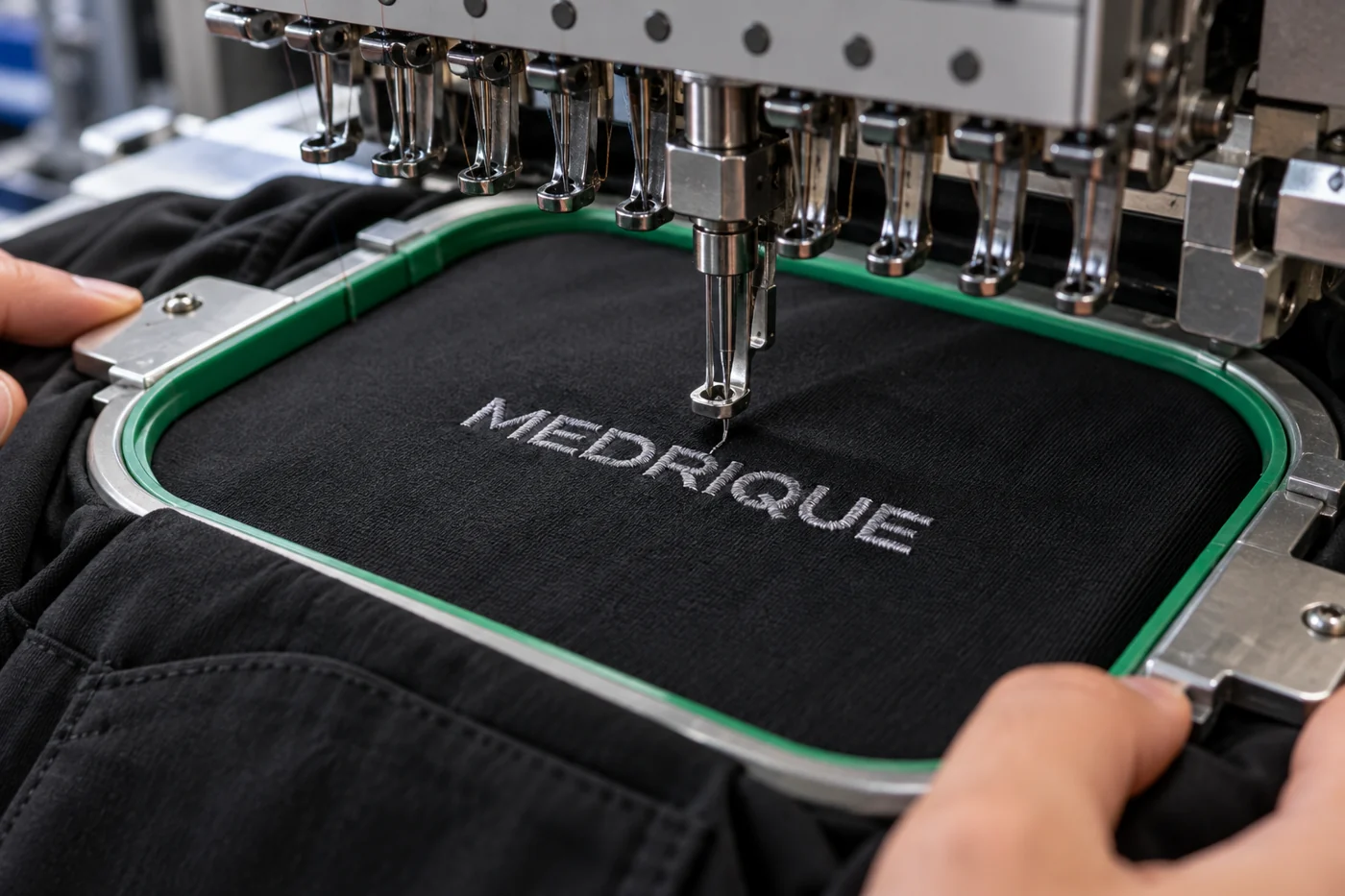
Black is the easiest colour to brand badly. High-contrast white or bright thread is perfectly legible, but it shouts, and on a premium programme it can cheapen a garment bought precisely because it looked expensive. Tonal embroidery, a thread a step or two off the ground colour, reads as considered rather than promotional, and it is what most private-practice and aesthetic clients settle on once they see both side by side.

Where a mark genuinely has to carry at distance, we usually suggest a small tonal logo at the chest and the full-contrast version on the back or the jacket, rather than compromising both. Woven labels, neck prints and heat-seal transfers all behave differently against black, and we would rather show you that on the sample than describe it in an email.

Detail on embroidery and logo branding, and on private label scrubs if the garments carry your brand rather than ours.

Medrique embroidery stitched on black scrub fabric
  1. Send the briefFabric, colour, garments and quantities, or as much as you actually have. Unsure on construction or minimums? We recommend rather than ask you to guess.
  2. Itemised quote in 1 dayEvery cost line separated, with a stage-by-stage timeline. Not a single number you have no way to interrogate.
  3. Lab dip approvedWe match to a Pantone reference or to a garment you send. You approve the physical dip, and that dip becomes the standard.
  4. Sample sealedYou sign off a production sample in your fabric and colour. It is sealed and kept here as the reference for every future bulk.
  5. Bulk and deliveryOne named contact, an update on a fixed day each week, packed to your specification and checked against the retained sample.
  • 30 units per style minimum
  • Per-colourway minimum quoted upfront
  • Reply within 1 business day
  • No obligation, and no minimum enquiry size
Ready to start? Send the briefFabric, colour, garments and quantities, or as much of it as you actually have. Itemised quote and a production timeline within one business day.
Start my quote

What we put in writing

Client reviews for this page sit here. Until they are published, these are the commitments we make in writing on every black order, which is what the reviews will be measured against.

Colour control

Your approved lab dip becomes the retained standard.

Every reorder is matched against a sealed physical reference kept here, not against a colour code written on a purchase order. On black it is the single thing that keeps a programme consistent across a year of repeat orders.

Specification

Fastness grades written into your quote before you order.

Wash fastness to ISO 105-C06, dry and wet rubbing to ISO 105-X12, light fastness to ISO 105-B02. Stated up front rather than discovered after your first laundry cycle.

Shade consistency

Tops and bottoms cut from a single dye lot.

Wherever the quantities allow, matched garments come off one lot, so a black top and a black pant still read as one uniform at the waist where they actually meet.

Straight answers

If your laundry will move the shade, we say so at quotation.

Where a facility uses bleach-based wipe-downs we either specify a bleach-tolerant construction or quote a replacement cycle you can budget for. We would rather lose the argument before the order than after delivery.

Swipe for more

THE CLIENT EXPERIENCE

Reviews from our community

Sample content: fictional names, portraits and reviews for layout preview. Replace these examples with genuine customer feedback.

SAMPLE REVIEW
“The sample process made it easy to compare fit, fabric and shade before planning a team order.”

Fictional sample portrait of Sarah Mitchell
Sarah MitchellFictional customer example

SAMPLE REVIEW
“A coordinated uniform makes a difference. The pocket layouts and colour options are exactly the details our team would look for.”

Fictional sample portrait of Michael Brooks
Michael BrooksFictional customer example
SAMPLE REVIEW
“Clear communication, useful size guidance and thoughtful branding would make a team rollout feel much easier.”

Fictional sample portrait of Emily Carter
Emily CarterFictional customer example

What buyers ask about this colour

Black looks like the safe choice and behaves like the least forgiving one. Here is what buyers raise before they commit to it.

Do black scrubs fade faster than other colours?

They do not lose dye faster in absolute terms, but the loss is far more visible. A ten per cent shade drop on a mid blue still reads as the same blue. The same drop on black reads as charcoal, and next to a newer garment it reads as a mistake. That is why we specify black against a stated wash-fastness grade rather than against a swatch.

Will black scrubs rub dye onto other fabrics?

Only if the dyeing was not finished properly. Crocking is caused by unfixed dye sitting on the fibre surface, which a reduction clear after dyeing removes. We specify that step and hold a dry and wet rubbing fastness grade to ISO 105-X12, so the garment does not mark seat covers, patient linen or the inside of a white coat.

Can black scrubs handle commercial or industrial laundering?

Yes, when they are built for it. Industrial laundering means higher temperatures, stronger chemistry and more mechanical agitation, so we move to a construction and a dye class chosen for that cycle rather than for a domestic machine. Tell us at quotation stage whether the garments go through a commercial laundry, because it changes both the fabric we recommend and the price.

Can you match a black we already use?

Yes. Send us a garment, ideally one new and one that has been through your laundry a few dozen times. We match to the physical piece rather than to a Pantone reference alone, then retain a sealed sample here as the standard every future order is assessed against.

What is the minimum order for custom black scrubs?

One hundred units per style, and we quote the per-colourway minimum at the same time so it does not surprise you later. If you are testing black before committing a whole department, say so and we will quote the trial and the rollout together.

Do black scrubs show lint more than other colours?

Yes, and after fade it is the complaint we hear most. Gauze, blanket fibre and dressing-pack fluff are pale and they sit on the surface. We counter it with a tighter knit, a higher-twist yarn and a pilling test, which stops loose fibre anchoring. It cannot be eliminated, but the difference between a specified black and an unspecified one is obvious by lunchtime.

Can we order black bottoms with a different coloured top?

Yes, and it is a common way to get the look of black inside a colour-coded facility. We quote it as one programme so both halves are cut from stock bought at the same time, which keeps the pairing consistent through the rollout.

Are black scrubs suitable for a colour-coded hospital?

Usually only where your code already assigns black to a role or leaves a category open. Black is far more common in dental, veterinary, aesthetic and private practice settings, where it reads as brand rather than as a role marker. Send us your dress code and we will tell you honestly whether black fits it before you order.

Do you make black scrubs in women's and men's fits, or only unisex?

All three, cut on separate blocks rather than one block sized up and down. Women's garments are drafted with a narrower, more sloped shoulder and shaping through waist and hip. Men's have a broader shoulder, a longer body and a rise and inseam graded for height rather than waist alone. Unisex sits alongside both for circulating stock. If you are buying for a mixed team, order the blocks together so they are cut from one dye lot.

Which fabric holds a black shade best?

Poly-spandex and four-way stretch performance fabrics hold black most reliably, because disperse dye at high temperature fixes into the polyester rather than sitting on the surface of it. Poly-cotton is the most common wholesale choice but fades unevenly if the union dyeing is rushed, since the cotton half gives up dye first and leaves a heathered cast. Cotton-rich gives the deepest black and is the least stable under hot institutional washing.

What logo colour works best on black scrubs?

Tonal embroidery, a thread a step or two off the ground colour, reads as premium and is what most private-practice and aesthetic clients choose. Full-contrast white or a brand colour is more legible at distance but can cheapen a garment bought precisely because it looked expensive. Where a mark has to carry across a room, we usually place a tonal logo at the chest and the contrast version on the back or the jacket.

Can you match black across tops, pants and jackets ordered at different times?

Yes, and this is the single most common reason a black programme goes wrong. We retain a sealed sample after your first approval and assess every later bulk against that physical garment rather than against a colour code. Where a rollout is staged across months we will hold fabric from the original lot rather than re-dye later, which is usually cheaper than scrapping mismatched garments afterwards.

Do you supply black scrubs to distributors and retailers for resale?

Yes. Black is normally the highest-turning line on a scrub range, so the real requirement is shade consistency across restocks rather than a single good match. We hold the approved standard between production runs, so a customer reordering one top receives something that matches the garments already in their wardrobe.

Still have a question about black?Ask it directly and get an answer from a named person rather than a brochure. No obligation, and no minimum enquiry size.
Ask a question

Related products

Building a full programme rather than one garment?Tops, bottoms, jackets and caps quoted together and cut from one approved lot, so the whole uniform matches on day one.
Quote the programme

Match your colour exactly

Send a Pantone code or a garment. We lab-dip it, you approve the dip, and that becomes the standard we hold for every future order.

No obligation, and nothing to commit to in order to ask. One named contact, and a reply within one business day.